As well as being an RSS junkie I confess that I am also a member of the the 'twitterazi'. Deprived of my regular Twitter fixes I suffer severe withdrawal symptoms. What is infobunny up to? Did Jillbrad manage to print her spreadsheet? Did Tebbo meet up with anyone at T5?
Persuading people that RSS is a good thing is not that difficult, but proving the value of Twitter is hard work. Chris Brogan's blog posting on 50 Ideas on Using Twitter for Business is a great starting point for ideas on how you can seriously use Twitter. He also lists 'The Negatives People Will Throw at You' and 'Some Positives to Throw Back'. My personal favourite in the list is number 11: Instead of answering the question, “What are you doing?”, answer the question, “What has your attention?"
Tuesday, 9 September 2008

Monday, 1 September 2008
Top Business Research Tips
Yes, I'm sorry, this is another Top !0 list from one of my workshops - a full day in-house session on Business Research. This time around Marketingfile.com made a return to the list at number 4 after a long absence, three of Alacra sites are at number 2 (nominated by participants as "All the Alacra sites"), and Twitter is at long last being considered as a serious business tool (Yay!!). It is worth noting that this group were interested in Second Life; some of their contacts and clients are involved with Second Life so it would have been useful to have a look at how it works . As usual, though, we could not connect to SL. It appeared that the ports used by SL were blocked by the by the organisation's network.
Here is the full list:
1. Internet Archive or Wayback machine at http://www.archive.org/. For pages, sites and documents that have disappeared. Ideal for tracking down lost documents and seeing how organisations presented themselves on the Web in the past.
2. "All the Alacra sites". Not strictly accurate in that it was just three of their business web sites that attracted attention:
3. Advanced Search. The advanced search screens of the likes of Google and Yahoo have many options for increasing the precision of your your search: file format (e.g. xls for data and statistics, ppt for expert presentations, pdf for industry or government reports); site and domain search to limit your search to just one web site or a type of organisation (e.g. UK government, US academic); and in Google there is a numeric range search.
4. Marketingfile.com at http://www.marketingfile.com/. A collection of lists with a bias towards UK and Ireland but there are some International, European and North American lists. The lists are divided into Business and Consumer and further categorised into sectors or type, for example Drinks Trade, Aviation & Defence, Smaller Companies. Each list can be searched by a number of criteria depending on its structure and coverage. Searching is free and data is charged for on a pay per record basis.
5. Freepint at http://www.freepint.co.uk/ Head for the discussion area, labelled as the Bar, where you can post your query and tap into the knowledge of regular ‘tipplers’
6. Trade Association Forum - http://www.taforum.org/ . A useful, searchable directory of UK trade associations.
7. Sector Skills Councils. This was not one that I mentioned in the workshop but is a resource that the organisation that I was visiting often uses. According to Wikipedia (http://en.wikipedia.org/wiki/Sector_Skills_Councils) , and please don't complain that I am citing it:
The workshop participants commented that "some of the councils are better than others".
8. Google, Yahoo, Live, Exalead, Ask. Let's admit it - much of the time we head for Google as our first port of call, but it is worth running your search in the other contenders. Results are sorted in a different order and they do have different coverage and search features.
9. Twitter - http://www.twitter.com/. "Looks interesting". "Need to try it out as a source of information". "Could be useful as a promotion/communications tool".
10. RBA Business Sources. http://www.rba.co.uk/sources/. Selected sources of business information organised by type e.g. statistics, share prices, company registers. Yes, my own site, the basis of the workshop notes, and as one person commented "It is the quickest way to get to all the sites you told us about"!
Here is the full list:
1. Internet Archive or Wayback machine at http://www.archive.org/. For pages, sites and documents that have disappeared. Ideal for tracking down lost documents and seeing how organisations presented themselves on the Web in the past.
2. "All the Alacra sites". Not strictly accurate in that it was just three of their business web sites that attracted attention:
Alacrawiki at http://www.alacrawiki.com/. The Alacra Spotlights section is a good starting point for evaluated sites and information on industry sectors. Note that although it is a wiki only Alacra can edit these pages.
Alacrasearch at http://www.alacra.com/alacrasearch/. A Google custom search engine that focuses on business sites selected by Alacra.
AlacraStore at http://www.alacrastore.com/. "Search over 70 million reports on more than 550,000 public companies and private companies from over 55 premium business information publishers." Search for free and pay as you go on your credit/debit card. A full lost of their content providers is at http://www.alacrastore.com/search-by/publisher.
3. Advanced Search. The advanced search screens of the likes of Google and Yahoo have many options for increasing the precision of your your search: file format (e.g. xls for data and statistics, ppt for expert presentations, pdf for industry or government reports); site and domain search to limit your search to just one web site or a type of organisation (e.g. UK government, US academic); and in Google there is a numeric range search.
4. Marketingfile.com at http://www.marketingfile.com/. A collection of lists with a bias towards UK and Ireland but there are some International, European and North American lists. The lists are divided into Business and Consumer and further categorised into sectors or type, for example Drinks Trade, Aviation & Defence, Smaller Companies. Each list can be searched by a number of criteria depending on its structure and coverage. Searching is free and data is charged for on a pay per record basis.
5. Freepint at http://www.freepint.co.uk/ Head for the discussion area, labelled as the Bar, where you can post your query and tap into the knowledge of regular ‘tipplers’
6. Trade Association Forum - http://www.taforum.org/ . A useful, searchable directory of UK trade associations.
7. Sector Skills Councils. This was not one that I mentioned in the workshop but is a resource that the organisation that I was visiting often uses. According to Wikipedia (http://en.wikipedia.org/wiki/Sector_Skills_Councils) , and please don't complain that I am citing it:
"Sector Skills Councils (SSCs) are state-sponsored, employer-led organisations that cover specific economic sectors in the United Kingdom. They have four key goals:
Further information on the Councils can be found at Alliance of Sector Skills Councils, http://www.sscalliance.org/home/home.asp.
- to reduce skills gaps and shortages
- to improve productivity
- to boost the skills of their sector workforces
- to improve learning supply"
The workshop participants commented that "some of the councils are better than others".
8. Google, Yahoo, Live, Exalead, Ask. Let's admit it - much of the time we head for Google as our first port of call, but it is worth running your search in the other contenders. Results are sorted in a different order and they do have different coverage and search features.
9. Twitter - http://www.twitter.com/. "Looks interesting". "Need to try it out as a source of information". "Could be useful as a promotion/communications tool".
10. RBA Business Sources. http://www.rba.co.uk/sources/. Selected sources of business information organised by type e.g. statistics, share prices, company registers. Yes, my own site, the basis of the workshop notes, and as one person commented "It is the quickest way to get to all the sites you told us about"!
Wednesday, 20 August 2008
Renewable Fuels Agency (RFA)
The Renewable Fuels Agency (RFA) (http://www.dft.gov.uk/rfa/) has been set up by the UK Government to implement the Renewable Transport Fuel Obligation (RTFO) (http://www.dft.gov.uk/rfa/aboutthertfo.cfm), which came into force on 1st April 2008. The RTFO obliges fossil fuel suppliers to ensure that by 2010 biofuels account for 5% by volume of the fuel supplied on UK forecourts. The purpose of the RTFO is to "reduce the UK's contribution to climate change and its reliance on fossil fuels". The RFA publishes updates on the progress of the RTFO. These include monthly reports on progress on achieving compliance with sustainability criteria and quarterly reports to the Department for Transport and annual reports to parliament. All reports are available on the web site.
With serious questions being raised about the impact of biofuels on food prices, farming and the environment in general, it will be interesting to see how long this all carries on. The RFA's first monthly report has just been published and covers the period 15th April - 14th May 2008. The press release contains some good summary statistics for those of us who need to get hold of such data in a hurry. There are 'associated files' (PDF and an Excel spreadsheet) that contain more detailed information.

With serious questions being raised about the impact of biofuels on food prices, farming and the environment in general, it will be interesting to see how long this all carries on. The RFA's first monthly report has just been published and covers the period 15th April - 14th May 2008. The press release contains some good summary statistics for those of us who need to get hold of such data in a hurry. There are 'associated files' (PDF and an Excel spreadsheet) that contain more detailed information.

The UK Coal Authority
The UK Coal Authority (http://www.coal.gov.uk) aims "to facilitate the proper exploitation of the Nation's coal resources, whilst providing information and addressing liabilities for which the Authority is responsible, in a professional, efficient and open manner".
If you own or are purchasing a property in a coal mining area there is a search service that will check whether or not the property might be affected by past or existing mining activity. The gazetteer (under Information Services) gives an indication of places in Great Britain that may, or may not, require a mining search to be performed. If you are thinking of moving within the UK it would be as well to check this site as well as the Environment Agency's 'In Your Backyard' (http://www.environment-agency.gov.uk/maps/), which tells you if the area is at risk of flood and whether there's a landfill site near your house.
The Coal Authority site also has reports on mining activity in the UK and statistics on production. There are links to sites that cover coal mining related topics and information on technologies. The latter includes coal gasification, cleaner coal technologies and environmental issues. These technology 'fact sheets' are a good starting point if you need to get up to speed on the industry jargon and how it all works.
If you own or are purchasing a property in a coal mining area there is a search service that will check whether or not the property might be affected by past or existing mining activity. The gazetteer (under Information Services) gives an indication of places in Great Britain that may, or may not, require a mining search to be performed. If you are thinking of moving within the UK it would be as well to check this site as well as the Environment Agency's 'In Your Backyard' (http://www.environment-agency.gov.uk/maps/), which tells you if the area is at risk of flood and whether there's a landfill site near your house.
The Coal Authority site also has reports on mining activity in the UK and statistics on production. There are links to sites that cover coal mining related topics and information on technologies. The latter includes coal gasification, cleaner coal technologies and environmental issues. These technology 'fact sheets' are a good starting point if you need to get up to speed on the industry jargon and how it all works.
Tuesday, 19 August 2008
Autumn one day training courses at Manchester Business School
The following business research skills courses are being run at Manchester Business School from September to October. And yes - I have a vested interest in that I am running the market research workshop!
Maximising Your Qualitative Research Skills and Results
Date: Wednesday 10 September
Trainer: Chris Murphy
Demonstrates this vital form of enquiry needed to make sense of qualitative data. Explores schemes for planning research projects, techniques for documentary evidence, obtaining information, then forming a roadmap for taking initial results further, appraising data quality and reporting findings
Project Management
Date: Tuesday 7 October
Trainer: Chris Murphy
This course provides a set of techniques for managing projects: determining project scope, planning and realisation, project team schedule and control, progress monitoring, software packages? contribution, corrective action if the project strays from course and project reporting
Market Research on the Web
Date: Tuesday 21 October
Trainer: Karen Blakeman
Practical guidance is offered for finding and evaluating statistical, market research and industry information, covering free and fee based services. Suitable for researchers compiling analyses of markets, looking for potential partners, clients, suppliers or who are responsible for competitor intelligence
For more information about the the programme content and course dates or to download a booking form, go to www.mbs.ac.uk/bis-training or call the Business Information Service on 0161 275 6503
Maximising Your Qualitative Research Skills and Results
Date: Wednesday 10 September
Trainer: Chris Murphy
Demonstrates this vital form of enquiry needed to make sense of qualitative data. Explores schemes for planning research projects, techniques for documentary evidence, obtaining information, then forming a roadmap for taking initial results further, appraising data quality and reporting findings
Project Management
Date: Tuesday 7 October
Trainer: Chris Murphy
This course provides a set of techniques for managing projects: determining project scope, planning and realisation, project team schedule and control, progress monitoring, software packages? contribution, corrective action if the project strays from course and project reporting
Market Research on the Web
Date: Tuesday 21 October
Trainer: Karen Blakeman
Practical guidance is offered for finding and evaluating statistical, market research and industry information, covering free and fee based services. Suitable for researchers compiling analyses of markets, looking for potential partners, clients, suppliers or who are responsible for competitor intelligence
For more information about the the programme content and course dates or to download a booking form, go to www.mbs.ac.uk/bis-training or call the Business Information Service on 0161 275 6503
Saturday, 16 August 2008
TouchGraph Google Browser
Thanks to Phil Bradley for the alert on this search visualisation tool.
TouchGraph is a Java application that loads into your browser window and displays the networks and connections in your data or a search results list. There are three free demos that tie into Google, Amazon and Facebook. I found the last two very cumbersome to use and limited in their usefulness but the Google one is worth a try. You type in your keywords or a URL and Google's results are presented as groups of interconnected 'blobs'. You can zoom in and out, hide or expand individual groupings and filter results, although I must admit to not having yet mastered the last feature.
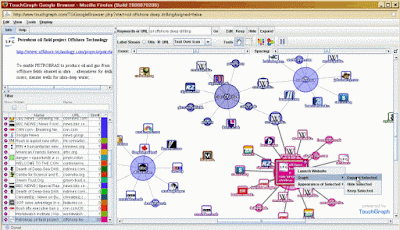
An interesting way to explore search results but I still prefer Cluuz's visualisation of web based data. I may find TouchGraph more useful for looking at connections and relationships within my locally held information so I have signed up for a TouchGraph Navigator trial.
TouchGraph is a Java application that loads into your browser window and displays the networks and connections in your data or a search results list. There are three free demos that tie into Google, Amazon and Facebook. I found the last two very cumbersome to use and limited in their usefulness but the Google one is worth a try. You type in your keywords or a URL and Google's results are presented as groups of interconnected 'blobs'. You can zoom in and out, hide or expand individual groupings and filter results, although I must admit to not having yet mastered the last feature.
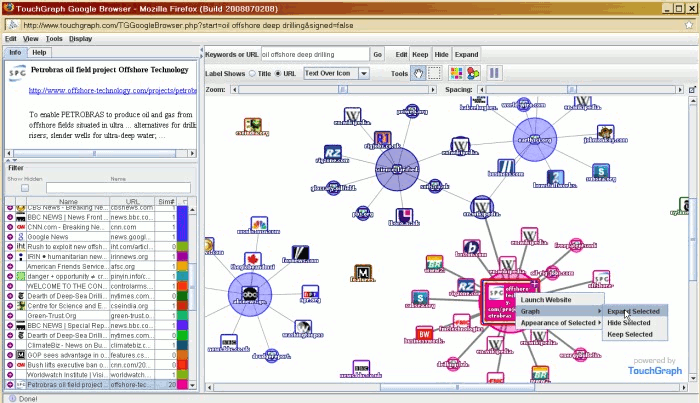
An interesting way to explore search results but I still prefer Cluuz's visualisation of web based data. I may find TouchGraph more useful for looking at connections and relationships within my locally held information so I have signed up for a TouchGraph Navigator trial.
Yahoo! drops Boolean NOT operator
I go away on holiday for three weeks and on my return disaster strikes. " Yahoo! drops Boolean support" was the headline that jumped out at me as I fired up my RSS reader. The story, carried by Pandia Search Engine News, refers to a report by Greg Notess in Online Magazine. I was not able to access the original in Online so had to make do with Pandia's summary and test out the claims myself.
It turns out that it is only the NOT operator that has vanished. Not such a catastrophe after all as you can still place a minus sign in front of the term that you want excluded from the search results. The posting goes on to say that nesting with parentheses has also been dumped. That was definitely not the case when I carried out test searches on both the UK and US versions of Yahoo. All of my nested Boolean searches worked, once I had replaced the NOTs with minus signs.
I shall wait a a week or so before assuming that the change is permanent. Earlier this year, the link and linkdomain commands went AWOL. They were no longer available on the main Yahoo sites but still worked on AltaVista. After a couple of days they reappeared on Yahoo as suddenly as they had vanished. Hopefully NOT will be back - it is easier to remember to use only Boolean operators rather than a mixture of Boolean and math signs - and fingers crossed that none of the other commands disappear.
It turns out that it is only the NOT operator that has vanished. Not such a catastrophe after all as you can still place a minus sign in front of the term that you want excluded from the search results. The posting goes on to say that nesting with parentheses has also been dumped. That was definitely not the case when I carried out test searches on both the UK and US versions of Yahoo. All of my nested Boolean searches worked, once I had replaced the NOTs with minus signs.
I shall wait a a week or so before assuming that the change is permanent. Earlier this year, the link and linkdomain commands went AWOL. They were no longer available on the main Yahoo sites but still worked on AltaVista. After a couple of days they reappeared on Yahoo as suddenly as they had vanished. Hopefully NOT will be back - it is easier to remember to use only Boolean operators rather than a mixture of Boolean and math signs - and fingers crossed that none of the other commands disappear.
Subscribe to:
Posts (Atom)