I am attending a round table discussion with Microsoft on Monday 29th June to discuss their new search tool Bing. Phil Bradley will be attending as will other Web 2.0 and Internet commentators. If you have any comments or feedback on Bing, or would like me to ask a question on your behalf, do please let me know.
We are being encouraged to blog, tweet etc the event so set your twitter search, alerting services or whatever to monitor the tag #meetbing
Sunday, 28 June 2009

Sunday, 21 June 2009
UK Historical Directories and Newspapers
Someone has just contacted me via Facebook asking how they could track down a company in London. Not a difficult piece of research you might say but the time period was the 1890s!
One resource that immediately sprang to mind was the Historical Directories at http://www.historicaldirectories.org/. This is a digital library, maintained by the University of Leicester, of local and trade directories for England and Wales, from 1750 to 1919. It does not attempt to publish every directory available between 1750 and 1919 but what they do have makes fascinating reading.
I first reviewed it in July 2004 and my initial interest was on the business side as I am sometimes asked how to find information on small, local companies going back 50 to 100 years. I quickly discovered, though, that for my own location (Caversham in Berkshire) the Kelly's directories for 1914 and 1915 included residential listings. I ended up spending hours researching who had lived in my house, who the neighbours had been and their occupations.
There are several search options including a keywords option that lets you search by any combination of location, decade, key name (directory name e.g. Kelly), your own keywords, and with fuzzy logic on or off (off is the default). For my own searches I found it easier to identify directories in my location and then search them individually, but one of the alternative search options may suit you better. For Berkshire I found Kelly's, Slater's and Webster's directories and there is a "Post Office" directory for Berkshire, Northamptonshire, Oxfordshire, Bedfordshire, Buckinghamshire and Huntingdonshire for 1854!

For each directory there is a Fact File containing bibliographic information and links to the main chapter headings. When you view the pages that match your search criteria your search terms are highlighted.
The site also supports seriously advanced search options (see http://www.historicaldirectories.org/hd/howto/howto7.asp#detailed for details). For a phrase just type in the words next to one another, for example Star Road. If, on the other hand, you are looking for a person their name may appear as surname, middle name(s), first name. For this type of search there is a "within" operator, for example George w/3 Bloggs will look for George within three words of Bloggs in any order. The wildcard is a question mark (?) and replaces a single character. The asterisk replaces 0 or more characters. Wildcards can be used at the beginning, in the middle or at the end of a word.
For information on who was hitting the headlines in your town in the 1890s you could try the recently launched British Newspapers 1800-1900 at http://newspapers.bl.uk/blcs/. This covers two million pages of 49 local and national 19th century newspapers. There is a basic search option on the home page but the advanced search enable you to search by keyword, publication date(s), place of publication, section (e.g. people, business), publication frequency and language (English or Welsh).
The problems start with the publications that are covered - only 49. Nothing in Berkshire so this is a non-starter for my own local search. Note also that you have to pay to view most of the articles. A 24 hour pass costs £6.99 and allows you to view up to 100 articles. A seven day pass costs £9.99 and gives you 200 article views.
I could not find out what the buzz was in Reading and Caverhsam in the 1800s from the British Library newspaper archive (perhaps there wasn't any!), but what do the directories have to say? According to the 1854 Post Office directory:

And who did live in my house in 1914/1915? Number 88 Star Road, or number 6 Webb's Cottages as it then was, was home to Charles Herbert and his wife Mary who was a shopkeeper. Neighbours included a wheelwright, carpenter, window cleaner, builder, two pub landlords and an insurance agent. Apart from the wheelwright, not very different from today's residents!
One resource that immediately sprang to mind was the Historical Directories at http://www.historicaldirectories.org/. This is a digital library, maintained by the University of Leicester, of local and trade directories for England and Wales, from 1750 to 1919. It does not attempt to publish every directory available between 1750 and 1919 but what they do have makes fascinating reading.
I first reviewed it in July 2004 and my initial interest was on the business side as I am sometimes asked how to find information on small, local companies going back 50 to 100 years. I quickly discovered, though, that for my own location (Caversham in Berkshire) the Kelly's directories for 1914 and 1915 included residential listings. I ended up spending hours researching who had lived in my house, who the neighbours had been and their occupations.
There are several search options including a keywords option that lets you search by any combination of location, decade, key name (directory name e.g. Kelly), your own keywords, and with fuzzy logic on or off (off is the default). For my own searches I found it easier to identify directories in my location and then search them individually, but one of the alternative search options may suit you better. For Berkshire I found Kelly's, Slater's and Webster's directories and there is a "Post Office" directory for Berkshire, Northamptonshire, Oxfordshire, Bedfordshire, Buckinghamshire and Huntingdonshire for 1854!

For each directory there is a Fact File containing bibliographic information and links to the main chapter headings. When you view the pages that match your search criteria your search terms are highlighted.
The site also supports seriously advanced search options (see http://www.historicaldirectories.org/hd/howto/howto7.asp#detailed for details). For a phrase just type in the words next to one another, for example Star Road. If, on the other hand, you are looking for a person their name may appear as surname, middle name(s), first name. For this type of search there is a "within" operator, for example George w/3 Bloggs will look for George within three words of Bloggs in any order. The wildcard is a question mark (?) and replaces a single character. The asterisk replaces 0 or more characters. Wildcards can be used at the beginning, in the middle or at the end of a word.
For information on who was hitting the headlines in your town in the 1890s you could try the recently launched British Newspapers 1800-1900 at http://newspapers.bl.uk/blcs/. This covers two million pages of 49 local and national 19th century newspapers. There is a basic search option on the home page but the advanced search enable you to search by keyword, publication date(s), place of publication, section (e.g. people, business), publication frequency and language (English or Welsh).
The problems start with the publications that are covered - only 49. Nothing in Berkshire so this is a non-starter for my own local search. Note also that you have to pay to view most of the articles. A 24 hour pass costs £6.99 and allows you to view up to 100 articles. A seven day pass costs £9.99 and gives you 200 article views.
I could not find out what the buzz was in Reading and Caverhsam in the 1800s from the British Library newspaper archive (perhaps there wasn't any!), but what do the directories have to say? According to the 1854 Post Office directory:

"BERKSHIRE, sometimes called Barkshire, and for shortness Berks or Barks, is a southern inland shire, on the south or left bank of the navigable Thames, which forms its northern boundmark, and in the valley of which it lies, approaching within twenty miles of London, and in the middle between the mouth of the Thames at the North Sea and the Bristol Channel. The shire is of very irregular shape..."
And who did live in my house in 1914/1915? Number 88 Star Road, or number 6 Webb's Cottages as it then was, was home to Charles Herbert and his wife Mary who was a shopkeeper. Neighbours included a wheelwright, carpenter, window cleaner, builder, two pub landlords and an insurance agent. Apart from the wheelwright, not very different from today's residents!
Monday, 1 June 2009
Bing - don't bother!
Bing.com has launched and I just cannot believe that Microsoft have made so much fuss over something that is no better than the existing Live.com. The UK version is labelled as beta and the US one as "Preview" so is there more coming soon as is suggested by Microsoft/Bing in their blogs? I sincerely hope so because so far this "decision engine" does not live up to the hype.
Phil Bradley has already reviewed Bing and I agree entirely with everything he has said. The home page is reminiscent of the old Ask home page that allowed you to "skin" the page with an image. I like the snow leopard that is on the UK version but if I should get bored with it, I can't change it.
My test web searches came up with results that were mostly identical with those from Live.com. For some of them, for example my search on car ownership UK, Bing puts a fact or a statistic at the top of the page. In this case it came up with 510 cars per 1000 people, a statistic apparently from the International Road Federation but 2004 data! The Advanced Search is as pathetic as ever, but you can use search commands such as 'filetype: ' and 'site:' in the standard search box.
The image search is virtually the same as Live's with minor changes to the layout. The Shopping option takes UK users to Ciao.co.uk (very confusing), News is as useless as before, and Maps takes you to Multimap. Much more interesting is the Google-type maps option at http://maps.live.com/ or http://maps.bing.com/ but you cannot find that by following the menu options. You have to know and enter the URL directly into your browser.
At present, all Microsoft seem to have done is put a slightly different interface on top of Live and given it a different domain name, an impression further reinforced by the help files still being on live.com. I will continue to use Live.com as one of my favourite alternative search engines: it does sometimes come up with unique content and I like the image search. Bing has nothing that is significantly new or innovative. As Phil Bradley says, what a wasted opportunity. Google can rest easy.
Phil Bradley has already reviewed Bing and I agree entirely with everything he has said. The home page is reminiscent of the old Ask home page that allowed you to "skin" the page with an image. I like the snow leopard that is on the UK version but if I should get bored with it, I can't change it.
My test web searches came up with results that were mostly identical with those from Live.com. For some of them, for example my search on car ownership UK, Bing puts a fact or a statistic at the top of the page. In this case it came up with 510 cars per 1000 people, a statistic apparently from the International Road Federation but 2004 data! The Advanced Search is as pathetic as ever, but you can use search commands such as 'filetype: ' and 'site:' in the standard search box.
The image search is virtually the same as Live's with minor changes to the layout. The Shopping option takes UK users to Ciao.co.uk (very confusing), News is as useless as before, and Maps takes you to Multimap. Much more interesting is the Google-type maps option at http://maps.live.com/ or http://maps.bing.com/ but you cannot find that by following the menu options. You have to know and enter the URL directly into your browser.
At present, all Microsoft seem to have done is put a slightly different interface on top of Live and given it a different domain name, an impression further reinforced by the help files still being on live.com. I will continue to use Live.com as one of my favourite alternative search engines: it does sometimes come up with unique content and I like the image search. Bing has nothing that is significantly new or innovative. As Phil Bradley says, what a wasted opportunity. Google can rest easy.
Friday, 29 May 2009
PATLIB 2009 presentations
The presentations that I gave at PATLIB 2009 in Sofia, Bulgaria lastweek are now available at http://www.rba.co.uk/patlib2009. There are two: a 25 minute presentation that was given as part of the main conference and the longer half day pre-conference workshop. As usual, many of the slides will probably not make sense without my commentary but you are welcome to email or Twitter DM me if you want more information.
There is also a two page "Getting started with Twitter" document. Yes, I know that there is a plethora of how-to-twitter pages on the web but almost none of them answer the questions that I am asked on my workshops. The best and most succinct that I have found so far is the two page http://portfolio.ginaminks.com/job_aides/twitter_cheat_sheet.pdf
There is also a two page "Getting started with Twitter" document. Yes, I know that there is a plethora of how-to-twitter pages on the web but almost none of them answer the questions that I am asked on my workshops. The best and most succinct that I have found so far is the two page http://portfolio.ginaminks.com/job_aides/twitter_cheat_sheet.pdf
Reading Evening Meeting, 2nd June - Business Resources at Slough Library
Organised by CILIP in the Thames Valley (formerly BBOD).
Venue: Great Expectations, 33 London St, Reading
Date & Time: Tuesday 2nd June 2009. 1800 for 1830 hrs
Business Resources at Slough Library
Lisa Hodgkins will provide details of the information resources available for business at the Slough Library. Slough Libraries continue to provide a high level of service in this area.
Followed by free refreshments and networking opportunities with colleagues.
An invitation is extended to anyone with a professional interest in the topic
Contact: Please contact Norman Briggs nwbriggs@pcintell.co.uk if you wish to attend.
Venue: Great Expectations, 33 London St, Reading
Date & Time: Tuesday 2nd June 2009. 1800 for 1830 hrs
Business Resources at Slough Library
Lisa Hodgkins will provide details of the information resources available for business at the Slough Library. Slough Libraries continue to provide a high level of service in this area.
Followed by free refreshments and networking opportunities with colleagues.
An invitation is extended to anyone with a professional interest in the topic
Contact: Please contact Norman Briggs nwbriggs@pcintell.co.uk if you wish to attend.
Saturday, 16 May 2009
Wolfram Alpha is out - hmmm...
After months of pre-launch hype Wolfram Alpha is now up and running for us all to try out. It has been labelled by some as a potential Google killer but it has always called itself a "computational knowledge engine" or fact search engine:
If you are interested in the background and aims of WolframAlpha the article in Searchengineland.com goes into more detail.
I am not going to go into any more background here, enlightening and informative though it is, because the average punter will not bother and will simply type in a query. This is where the trouble starts. You have to understand that WolframAlpha deals with data and statistics, but only certain types of data. If you are looking for market share data, forget it. My test search on gin vodka sales UK came up with what was to be the all too common:
This morning's tweets #wolframalpha suggested that it is very good at comparing country data. It provided some very basic data when I looked at UK and France but adding a third (Germany) caused it to totally lose the plot. Some data was labelled with the country but for the rest I was left guessing.
As WolframAlpha has a scientific bias I tried it on Planck's constant, which it got right (but then so does Google in big bold letters at the top of the results list). Spinach vitamin C was another winner, but trying to compare it with mango and broccoli was more of a challenge. If you type in spinach mango broccoli Vitamin C, WolframAlpha only looks for vitamin C in broccoli. You have to type in 'spinach and mango and broccoli vitamin C'. It came up with a table for vitamin C levels for all three but there is only one nutritional facts table and it is not labelled.
I then decided to see if could come up with information on the origin of petroleum. Another fail as it tried to look for the origin of the word petroleum.

How about zeolites then? No it asked me if I meant websites.

Next stop companies, which WolframAlpha suggests it can handle. It provided limited share price data on Royal Dutch Shell and even managed to compare it with BP and Tullow Oil. The information is rather spartan and you would be far better off going to Yahoo Finance or Google Finance for information on listed companies. WolframAlpha failed totally when I added in Heritage Oil. Was a fourth company too much? I did a separate search on Heritage Oil and it simply did not recognise the company.

Now, come on - Heritage Oil is on the London Stock exchange, which is where I thought WoframAlpha was getting its data (or so the labelling implied) but that may not be the case. When you look at the Source Information it says
For me, this is a major issue. I need to know where the information has come from and a list of possible sources is not good enough.
It is still very early days for WolframAlpha, so it may eventually live up to expectations. It has long way to go and there are major problems to address:
1. The types of query that it can handle are limited and this needs to be made more obvious to the average searcher
2. The way you phrase your search is important. For some of my test searches I had to try four or five variations before it came up with any results. The average searcher will give up after the first attempt and go back to Google.
3. Some of the information is seriously out of date.
4. Sources are not directly linked to the data. It is essential that one knows where the information has come from.
I shall go back on a regular basis to see how it is progressing but for the present I am sticking with my existing favourite sources for serious research.
"Wolfram Alpha is backed by Stephen Wolfram, the noted scientist and author behind the Mathematica computational software and the book, A New Kind Of Science. The service bills itself as a “computational knowledge engine,” which is a mouthful. I’d call it a “fact search engine” or perhaps an “answer search engine,” a term that’s been used in the past for services designed to provide you with direct answers, rather than point you at pages that in turn may hold those answers."
From Impressive: The Wolfram Alpha “Fact Engine” http://searchengineland.com/wolfram-alpha-fact-engine-18431
If you are interested in the background and aims of WolframAlpha the article in Searchengineland.com goes into more detail.
I am not going to go into any more background here, enlightening and informative though it is, because the average punter will not bother and will simply type in a query. This is where the trouble starts. You have to understand that WolframAlpha deals with data and statistics, but only certain types of data. If you are looking for market share data, forget it. My test search on gin vodka sales UK came up with what was to be the all too common:
"Wolfram|Alpha isn't sure what to do with your input."
Half a dozen searches later it found an answer for one of my test queries - world oil production. The answer was correct but horrendously out of date: an estimate for 2004. The same search in Google came up with figures for 2008 and estimates for 2009.
It managed to the find the population of the UK but when I asked it for the population of Caversham it decided that I really meant Faversham. Google wins again on this one.
This morning's tweets #wolframalpha suggested that it is very good at comparing country data. It provided some very basic data when I looked at UK and France but adding a third (Germany) caused it to totally lose the plot. Some data was labelled with the country but for the rest I was left guessing.
As WolframAlpha has a scientific bias I tried it on Planck's constant, which it got right (but then so does Google in big bold letters at the top of the results list). Spinach vitamin C was another winner, but trying to compare it with mango and broccoli was more of a challenge. If you type in spinach mango broccoli Vitamin C, WolframAlpha only looks for vitamin C in broccoli. You have to type in 'spinach and mango and broccoli vitamin C'. It came up with a table for vitamin C levels for all three but there is only one nutritional facts table and it is not labelled.
I then decided to see if could come up with information on the origin of petroleum. Another fail as it tried to look for the origin of the word petroleum.

How about zeolites then? No it asked me if I meant websites.

Next stop companies, which WolframAlpha suggests it can handle. It provided limited share price data on Royal Dutch Shell and even managed to compare it with BP and Tullow Oil. The information is rather spartan and you would be far better off going to Yahoo Finance or Google Finance for information on listed companies. WolframAlpha failed totally when I added in Heritage Oil. Was a fourth company too much? I did a separate search on Heritage Oil and it simply did not recognise the company.
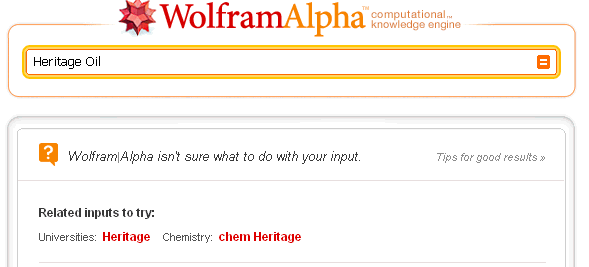
Now, come on - Heritage Oil is on the London Stock exchange, which is where I thought WoframAlpha was getting its data (or so the labelling implied) but that may not be the case. When you look at the Source Information it says
"This list is intended as a guide to sources of further information. The inclusion of an item on this list does not necessarily mean that its content was used as the basis for any specific WolframAlpha result.
For me, this is a major issue. I need to know where the information has come from and a list of possible sources is not good enough.
It is still very early days for WolframAlpha, so it may eventually live up to expectations. It has long way to go and there are major problems to address:
1. The types of query that it can handle are limited and this needs to be made more obvious to the average searcher
2. The way you phrase your search is important. For some of my test searches I had to try four or five variations before it came up with any results. The average searcher will give up after the first attempt and go back to Google.
3. Some of the information is seriously out of date.
4. Sources are not directly linked to the data. It is essential that one knows where the information has come from.
I shall go back on a regular basis to see how it is progressing but for the present I am sticking with my existing favourite sources for serious research.
Tuesday, 5 May 2009
BBOD mashups presentation
My presentation on mashups, which I am giving at the BBOD evening meeting today (5th May 2009), is now available on Slideshare, authorSTREAM and Slideboom. Choose your favourite presentation site and download.
It consists mostly of screen shots so it probably won't make much sense on its own. You'll have to come to the meeting!
Subscribe to:
Posts (Atom)