Showing posts with label workshops. Show all posts

Thursday, 28 April 2016

Advanced Google workshop - Top Tips

This collection of Top Tips is a combined list nominated by those who attended the UKeiG workshop on “New Google, New Challenges”. The next UKeiG Google workshop will be run on 8th September 2016.

1. Do not trust Google’s facts and answers
Google tries to provide facts and quick answers to your queries at the top and to the right of your results. These are computer generated extracts from pages and several different sources may be used to produce an “answer”. They are sometimes misleading or completely wrong. At the time of writing, the answer provided for a search on frugivore is an excellent example. (It explains why your cat is so fussy over its food – it is obviously craving its 5 a Day!) Always go to the original source to double check the information, but this is not always provided by Google.

2. Country versions of Google and /ncr
Country versions of Google give priority to the local content. This is a useful strategy when searching for research groups, companies and people that are active or working in a particular country. Use the standard ISO two letter country code, for example http://www.google.fr/ for Google France, http://www.google.it/ for Google Italy.

It is also worth trying your search in Google.com. Your results will probably be more international or US focused but you may see new search features or layouts in Google.com that are not yet available elsewhere. If Google insists on redirecting you to your own country version, go to the bottom right hand corner of the Google home page and you should see a link to Google.com. If there is no link then add ‘/ncr’ to the Google URL, for example http://www.google.com/ncr .

The downside of using country versions of any search tool is that the prioritised information is likely to be in the local language.

3. Search history
Your search history, which is recorded and available for you to view if you are signed in to your Google account, is used by Google to help personalise your results but it can also be useful as a record of past searches. If a user comes back to you having forgotten or lost the search and documents you gave them your search history should be able to help you find both. On any search results page click on the cog wheel in the upper right hand area of the screen and select History. You can then browse your history or select a date from the calendar (upper right and area of the History screen).

4. Verbatim
This is an essential tool for making Google carry out your search the way you want it run. Google automatically looks for variations on your terms and sometimes drops terms from your search, which is not always helpful. To use Verbatim, first run your search. Then click on ‘Search tools’ in the menu that runs across the top of your results page. A second row of options should appear. Click on ‘All results’ and from the drop down menu select Verbatim. Google will then search for your terms without any variations or omissions. Note that Google will search for documents and pages in which the words appear in any order. If you are searching on the title of a paper place the title within double quote marks to force an exact phrase match. If Google still alters your search then run Verbatim. 
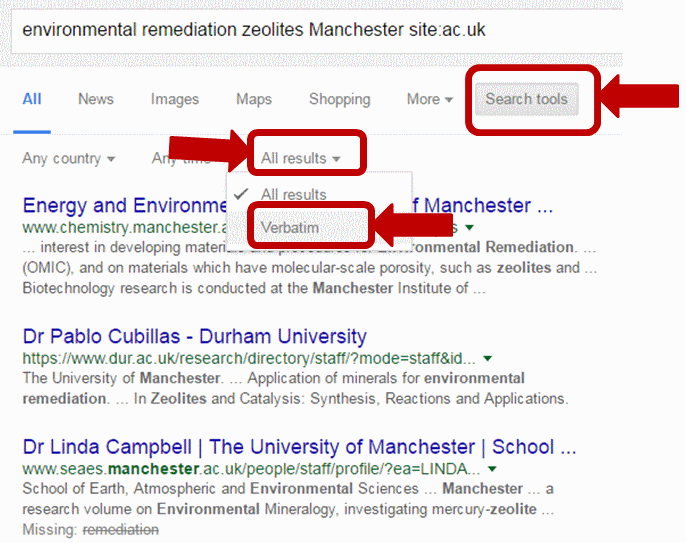
Verbatim-Factsheet
If you are carrying out in-depth research it is worth trying out Verbatim even if the “normal” Google results seem OK. You may see very different and possibly more relevant content.

5. filetype: command.
An important advanced search command that is available not only in Google but in many alternative search tools. Use the filetype: command to limit your research to PowerPoint for presentations, spreadsheets for data and statistics, or PDF for research papers and industry/government reports.

For example:

plasmonic nanoparticles filetype:ppt

The command must be all lower case and there must be no spaces between the colon and the command or the file extension, otherwise Google will treat the command as a searchable word. Also you must search for pre and post Office 2007 file extensions separately as Google does not automatically pick up both.

For example

plasmonic nanoparticles filetype:ppt OR filetype:pptx

Note that Google’s Advanced Search screen pull down menu for filetype: only searches for pre Office 2007 extensions.

6. Minus sign to exclude information
Use the minus sign immediately before a term to exclude documents containing that term, but use with care as you may lose valuable information. It can also be used with commands to exclude file formats or websites from your search.

For example:

occupational asthma UK site:gov.uk -site:hse.gov.uk
-site:nationalarchives.gov.uk


7. Combine search commands
Combine multiple commands such as filetype: and site: to focus your search. Use the OR command to search for alternatives, for example:

occupational asthma UK site:ac.uk filetype:ppt OR filetype:pptx

8.Personalise Google News
Personalise Google News (http://news.google.co.uk) page when signed in to your account  and change what content is automatically displayed or add your own searches. Click on the Personalise button at the top of the right hand column. 

9. Google Scholar Cite feature
Click on the Cite link under a reference in Google Scholar and Google will give you options to import a citation in MLA, APA, Chicago, Harvard or Vancouver style into BibTex, EndNote, RefMan or RefWorks. Note that if the article is only available online you may need to add a doi or a URL, and the date of access.

10. Use Google site: search on Google scholar
This is one I had not thought of but was recommended by one of the delegates as a way of using Google’s advanced search commands on Google Scholar instead of Scholar's own. (I have not had time to test this one out myself).

Friday, 11 April 2014

Google Top 10 Search Tips

These are the top 10 tips from the participants of a recent workshop on Google, organised by UKeiG and held on 9th April 2014. The edited slides from the day can be found on authorSTREAM at http://www.authorstream.com/Presentation/karenblakeman-2121264-making-google-behave-techniques-better-results/ and on Slideshare at http://www.slideshare.net/KarenBlakeman/making-google-behave-techniques-for-better-results

1. site: 
Use the site: command to focus your search on particular types of site, for example site:nhs.uk for UK NHS websites, or to search inside a large rambling site. If you prefer you can use the Advanced search screen at http://www.google.co.uk/advanced_search and fill in the site or domain box

2. Verbatim
An essential tool for making Google behave and run your search the way you want it run. Google automatically looks for variations on your terms and sometimes drops terms from the search. To make Google run your search exactly as you have typed it in, first run your search. Then click on ‘Search tools’ in the menu above your results. In the second line of options that appears click on ‘All results’ and from the drop down menu select Verbatim.

3. intext:
Google’s automatic synonym search can be helpful in looking for alternative terms but if you want a term to be included in your search exactly as you have typed it in then prefix the word with intext:. For example heron island intext:parrots caversham UK.

4. Incognito/Private browsing
Even if you are not signed in to a Google account, Google personalises your results according to your search and browsing behaviour. If you want to burst out of the filter bubble, as it is often called, use a private browser window or incognito (Chrome). Google will then ignore tracking and search cookies on your machine. To call up a private browser or incognito window use the following keys:

Chrome –  Ctrl+Shift+N
FireFox – Ctrl+Shift+P
Internet Explorer – Ctrl+Shift+P

5. Reading level
This changes the emphasis of the results that you see. Run your search and from the menu above the results select ‘Search tools’, then ‘All results’, and from the drop menu ‘Reading level’. Options for switching between basic, intermediate and advanced reading levels should then appear just above the results. Click on the Advanced option to see results biased towards research.

6. Date
To limit your search by date, for example the last month or year, first run your search. Then click on ‘Search tools’ in the menu above the results and from the second row of options that appears click on ‘Any time’. Select your time period or a custom range from the drop down menu. Unfortunately, this does not work with Verbatim. You could use the 'daterange:' command instead to specify your dates and then apply Verbatim, but you first have to convert you dates to Julian format. The Julian Date Converter at http://aa.usno.navy.mil/data/docs/JulianDate.php tells you more about the format and provides a tool for converting dates. Alternatively, using something like Gmacker (http://gmacker.com/web/content/gDateRange/gdr.htm). This enables you to enter your search terms and select your dates from a calendar. It then runs your search and on the Google results page you can apply Verbatim in the usual way.

7. CachedThe cached option enables you to view the copy of the page that Google has in its database. This is useful when the current version of a page seems to differ signicantly from the one described in the Google search results. Click on the little green arrow next to the URL of the page on the results list and then select Cached.


8. filetype:
Use the filetype: command to limit your research to PowerPoint for presentations, spreadsheets for data and statistics or PDF for research papers and industry/government reports. One workshop participant found it to be a great way to track down conference poster presentations by combining PDF and PowerPoint filetypes with keywords and the term 'poster'.

9. Country versions of Google
The country versions of Google give priority to the country’s local content, although it might be in the local language. This is a useful strategy when searching  for industries, companies and people that are active in a particular country. Use the standard ISO two letter country code, for example http://www.google.fr/ for Google France, http://www.google.it/ for Google Italy.

10. Books - About this magazine
Several people were interested in Google Books and in the magazine archives in particular. Google does not, though, make it easy to browse a magazine's archives. Once you have identified a series that is of interest it would seem logical to click on "Browse all issues" to view a list of what is available.

However, it seems to list the years of the issues randomly. Selecting "About this magazine" brings up some brief information about the title and links that enable you to browse past issues by year.

Thursday, 28 November 2013

Top search tips from Exeter and Bristol

A couple of weeks ago I was in Exeter and Bristol leading workshops for NHS South West on "Google & Beyond". We covered advanced Google commands, Google Scholar and alternatives to Google. Below are the combined top tips from the two sessions. I may have missed a couple from the list as I could not read my writing, so if you attended one of the workshops let me know if I've omitted your suggested tip.
  1. Verbatim Yet again, this has topped the list of useful Google search options. Google automatically looks for variations on your search terms and sometimes drops terms from your search without telling or asking you. To make Google run your search exactly as you have typed it in, first run your search. Then click on ‘Search tools’ in the menu above your results, in the second line of options that appears click on ‘All results’ and from the drop down menu select Verbatim.

  2. Be aware of personalisation. Even if you are not signed in to a Google account Google personalises your results according to your search and browsing behaviour. Personalisation is not necessarily a bad thing but if your want to burst out of the filter bubble, as it is often called, use a private browser window or incognito (Chrome). Google will then ignore tracking and search cookies on your machine and will not personalise your results. To call up a private browser or incognito window use the following keys:
Chrome -  Ctrl+Shift+N
FireFox - Ctrl+Shift+P
Internet Explorer - Ctrl+Shift+P
  1. site: Use the site: command to focus your search on particular types of site, for example site:nhs.uk, or to search inside a large, rambling site. You can also use -site: to exclude sites from your search.

  2. intext: Google’s automatic synonym search can be helpful when looking for alternative terms, but if you want a term to be included in your search exactly as you have typed it then prefix the word with intext:.

  3. filetype: Use the filetype: command to limit your research to PowerPoint for presentations, spreadsheets for data and statistics or PDF for research papers and industry/government reports. Note that in Google filetype:ppt and filetype:xls will not pick up the newer .pptx and xlsx formats so you will need to include those in your strategy, for example filetype:ppt OR filetype:pptx, or run separate searches for each one. In Bing.com, though, filetype:pptx will pick up both .ppt and .pptx files.

  4. Advanced search commands and search options Learn how to use the search commands (for example intext:, filetype: and site:). Many of these can be used on the advanced search screen that can usually be found under the cog wheel in the  upper right hand area of the screen, but that link sometimes disappears so learning the commands is a better bet. A list of the more useful Google commands is at http://www.rba.co.uk/search/SelectedGoogleCommands.shtml.

  5. Combine advanced search commands. Practise combining the advanced search commands for a more precise, focused set of results.

  6. Google Reading level. This changes the type of results that you see. Run your search and from the menu above the results select ‘Search tools’, ‘All results’ and from the drop menu ‘Reading level’. Options for switching between basic, intermediate and advanced reading levels should then appear just above the results. Click on the Advanced option to see results biased towards research. Google does not give much away as to how it calculates the reading level and it has nothing to do with the reading age that publishers assign to publications. It seems to involve an analysis of sentence structure, the length of sentences, the length of the document and whether scientific or industry specific terminology appears in the page.

  7. Numeric range. This command is unique to Google. Use it for anything to do with numbers – years, temperatures, weights, distances, prices etc. Simply type in your two numbers separated by two full stops as part of your search. This is a good way of limiting your search, for example, to forecasts over the few years.

  8. Limiting your search by date. To limit your search by date, for example the last month or year, first run your search. Then click on 'Search tools' in the menu above the results and from the second row of options that appears click on 'Any time'. Select your time period or a custom range from the drop down menu.

  9. Use the minus sign to exclude documents containing a word. If you do not want documents containing a specific word prefix that word term with a minus sign. The minus sign can also be used with commands such as site: and filetype: to remove an individual site or type of document from your results.

  10. Million Short http://millionshort.com/. If you are fed up with seeing the same results from Google again and again give Million Short a try. Million Short runs your search and you can choose to remove the most popular web sites from the results. Originally, as its name suggests, it automatically removed the top 1 million but now you can choose to remove the most popular 100, 1000, 10k, 100k or million sites. The page that best answers your question might not be well optimised for search engines or might cover a topic that is so “niche” that it never makes it into the top results in Google or Bing.

  11. Creative commons searches for images. Rather than search for images and go through them individually to find one that you can legally use in your document or presentation, use advanced search options or tools that allow you to select the appropriate license from the start. In Google, use the usage rights menu on the image advanced search screen to search for images with the license you need. The US version of Bing images includes a license option in the menu at the top of your results.

    Double check the license of the photo on the website or blog hosting it. The license you need may be associated with a different image and yours could, for example, be 'all rights reserved'.Flickr has a page where you can search for images with a specific Creative Commons license at http://www.flickr.com/creativecommons.
  1. Compare in Google. This is not a Google command but if you type in a search such as compare carrots with cabbage Google will create a table comparing the properties of the two items. Google has been known to get some of the data wrong, though, so it's worth double checking the figures before you use them.

  2. Web archives. Want to see what was on a website a few years ago or trying to track down a document that seems to have vanished from the web? Try the Internet Archive Wayback Machine at http://www.archive.org/. Enter the URL of the website or document and you should then see a calendar of the snapshots that the archive has of the site or document. Choose a date from the calendar to view the page. The archive does not have everything but it is worth a try. See also the UK National Archives of old government websites and pages at http://www.nationalarchives.gov.uk/webarchive/ and the UK Web Archive at http://www.webarchive.org.uk/ukwa/.

  3. Statistics sites. Although you can often find statistics via Google, you may find dedicated official statistics sites quicker and more reliable. Some of the sites we covered during the workshops were:

    NHS Statistics Links http://www.nhs.uk/Pages/LinkListing.aspx?CategoryId=Statistics
    UK National Statistics Publication Hub http://www.statistics.gov.uk/
    Office for National Statistics http://www.ons.gov.uk/
    Welsh Government Statistics http://wales.gov.uk/topics/statistics/
    Welsh Assembly Government StatsWales http://statswales.wales.gov.uk/
    UK Open data http://data.gov.uk/
    Eurostat http://ec.europa.eu/eurostat/
    European Union Open Data Portal http://open-dat.europa.eu/en/
    Zanran http://www.zanran.com/


Friday, 20 September 2013

Top tips from the latest business information workshop

Delegates at yesterday's business information workshop in London came up with an interesting combination of websites and search commands for their end of day top tips.
  1. OFFSTATS - Official Statistics on the Web  http://www.offstats.auckland.ac.nz Excellent starting point for official statistical sources by country, region subject or a combination of categories. All of the content in the database is in the public domain and available through the Internet.
  2. GMacker http://gmacker.com/web/content/gDateRange/gdr.htm Google's Verbatim in the search options menu on the results page is great. Google's date option from the same menu is great. But you cannot use both together. You can use the daterange: command, though, with Verbatim but it's complicated. GMacker is a much easier way to do it. Type in your search on the GMacker page, select your dates from the calendars and click on 'Google Search'. When the results appear on Google simply apply Verbatim in the usual way.

  3. Domain Tools http://www.domaintools.com/ A useful tool for identifying who owns the domain name of a website.

  4. 7 side http://www.7side.co.uk/ was recommended for its International company information services.

  5. Zanran http://zanran.com/This is a search tool for searching information contained in charts, graphs and tables of data and within formatted documents such as PDFs, Excel spreadsheets and images. Enter your search terms and optionally limit your search by date and/or format type.

  6. News alerts, news curation services and automated newsletter generation. Use Google alerts, RSS feeds and newsletter generation sites such as Paper.li (http://paper.li/) and Scoop.it (http://www.scoop.it/) to keep up to date and share news with colleagues.

  7. site: command Use the site: command to focus your search on particular types of site, for example site:ac.uk, or to search inside a large rambling site. You can also use -site: to exclude sites from your search.

  8. Numeric range This command is unique to Google. Use it for anything to do with numbers – years, temperatures, weights, distances, prices etc. Simply type in your two numbers separated by two full stops as part of your search. A good way of limiting your search to pages or news covering a company's activities over two or three years in the past.

  9. OpenCorporates "The Open Database Of The Corporate World" http://opencorporates.com/ Provides access to open corporate data on 55 million companies in 75 jurisdictions. You can search all jurisdictions at the same time or select just one. Results can be filtered by type of data held, current status, company type, SIC. A link to the original registry page for a company is always included with the displayed information.

  10. DataMarket http://datamarket.com/ A portal to thousands of free and priced datasets. Free to search, and create charts and visualisations of the free data.

Friday, 12 July 2013

Top Tips from SWAMP

Towards the end of June I headed off to Swansea Central Library to facilitate a workshop on search tools and techniques for finding business information and statistics.

The session was organised for the libraries of the wonderfully named SWAMP - South West and Mid Wales Partnership.

We had fantastic views from the library of the sea and shore line so they did very well to remain focused on the work in hand. The top tips that the group suggested at the end of the day were a mixture of search techniques and business information sites.

1. Persistence.
Don't give up and don't get stuck in a rut. If your first attempts fail to produce anything useful try a different approach to your search. Try some of the tips mentioned below: use advanced search commands, a different search tool or go direct to a website that covers your subject area or type of information.

 2. Verbatim.
Google automatically looks for variations on your search terms and sometimes drops terms from your search without telling or asking you. To beat Google into submission and make it run your search exactly as you have typed it in, click on ‘Search tools’ in the menu above your results, then click on the arrow next to ‘All results’ and from the drop down menu select Verbatim.

3. Private Browsing.
To stop search engines personalising your results according to your previous searches and browsing behaviour, find out where the private browsing option is in your browser (in Chrome it is called Incognito). This ignores all cookies and past search history and is as close as you can get to unfiltered results.

Short cuts to private browsing in the main browsers are:
Chrome - Ctrl+Shift+N

FireFox - Ctrl+Shift+P

Internet Explorer - Ctrl+Shift+P

Opera - Ctrl+Shift+N

Safari – click on Safari next to the Apple symbol in the menu bar, select Private Browsing and then click on OK.

4. The site: command.
Include the site: command in your search to focus your search on particular types of site, for example site:ac.uk, or to search inside a large rambling site. You can also use -site: to exclude sites from your search. For example, if you are searching for information on Wales and Australian websites mentioning New South Wales keep coming up include -site:au in your search.

5. The filetype: command.
Use the filetype: command to limit your research to PowerPoint for presentations, spreadsheets for data and statistics or PDF for research papers and industry/government reports. Note that in Google filetype:ppt and filetype:xls will not pick up the newer .pptx and xlsx formats so you will need to incorporate both into your strategy, for example filetype:ppt OR filetype:pptx, or run separate searches for each one. In Bing.com, though, filetype:pptx will pick up both .ppt and .pptx files.

6. Guardian Data Store (http://www.guardian.co.uk/data/)
For datasets and visualisations relating to stories in the news. This is proving to be a very popular site on both the public and in-house workshops. As well as the graphs and interactive maps the source of the data is always given and there are links to the original datasets that are used in the articles.

7. Company Check (http://www.companycheck.co.uk/)
Company Check repackages Companies House data and provides 5 years of figures and graphs for Cash at Bank, Net Worth, Total Liabilities and Total Current Liabilities free of charge. It also  lists the directors of a company. Click on a director’s name and you can view other current and past directorships for that person.

8. BL BIPC industry GuidesThe British Library Business Information and IP Centre’s industry guides at  http://www.bl.uk/bipc/dbandpubs/Industry%20guides/industry.html highlight relevant industry directories, databases, publications and web sites. Excellent starting points if you are new to the sector.

9. Web archives for documents, pages and sites that are no longer "live".
Most people know about the Internet Archive's Wayback Machine at http://www.archive.org/and its collection of snapshots of websites taken over the years. There is also a collection of old UK government webpages at http://www.nationalarchives.gov.uk/webarchive/, and the British Library has a UK web archive at http://www.webarchive.org.uk/ukwa/.

10. Keep up to dateKeep up to date with what the search engines are up to, changes to key resources and new sites. Identify blogs and commentators that are relevant to your research interests and subject areas and follow them using RSS or email alerts.

Thursday, 20 June 2013

North Wales Libraries Partnership Top Tips


The John Spalding Library in Wrexham hosted the North Wales Libraries Partnership (NWLP) workshop "Search is more than just Google". Delegates from public, government, academic and NHS libraries gathered together to look at the effect of mobile technologies on search, open access, getting better results from Google and alternative search tools.

The consensus reached during one of the breaks was that Cyril, one of the library's residents and pictured on the left, should have ignored Google's nutrition advice and gone for the more authoritative sources available in the library and on the web. If only he had waited and attended the workshop he would have known exactly where to look!

There was much discussion on how mobile devices change how we can search - not always for the best - and there was concern, as usual, over how much we willingly give away about ourselves to services such as Google and Facebook. Open access was debated in the afternoon along with possible directions for academic publishing.


The Top Tips that the group came up with included some of the usual advanced Google commands but others concerned cloud computing and social media. Here they are.

1. Back up your stuff. Having your data hosted in the cloud means you don't have to worry about it disappearing when your laptop or server crashes. But what if your cloud service goes under or your account is deleted for some reason? Have you made a local backup of your essential files and treasured family photos? One of the participants mentioned the Library of Congress digital preservation toolkit for preserving family memories (http://www.digitalpreservation.gov/personalarchiving/).

2. Private browsing for "un-personalising" search results. If you want to make sure that your results are not being influenced by past searches and browsing behaviour, find out where the private browsing option is in your browser (in Chrome it is called Incognito). This ignores all cookies and past search history and is as close as you can get to unfiltered results.

3. Change the order of your search terms to change the order in which results are listed. This is an old trick but still seems to work.

4. Use advanced search commands such as site:, filetype;, intext:, to focus your search. Some of the commands are available not just in Google but also in Bing and DuckDuckGo.

5. Create "newspapers" of articles mentioned on Twitter, Facebook, Google+ or news sites by using services such as Paper.li (http://paper.li/). These can be generated from hashtags, keyword searches or your own Twitterstream. Have a look in the Paper.li news stand to see if someone has already created a paper on your topic. Paper.li automatically compiles the newspaper but there are other services such as Storify (http://storify.com/) and Scoop.it (http://www.scoop.it/) that enable individuals to curate the content that appears in their personal newspaper.

6. Guardian Data Store for datasets and visualisations relating to stories in the news (http://www.guardian.co.uk/data). This was so popular that it was mentioned twice for inclusion in the top tips. What people liked about this is that the source of the data is always given and there are links to the original datasets.

7. Million Short http://millionshort.com/. If you are fed up with seeing the same results from Google again and again give Million Short a try. Million Short runs your search and then removes the most popular web sites from the results. Originally, as its name suggests, it removed the top 1 million but the default has changed to the top 10,000. The page that best answers your question might not be well optimised for search engines or might cover a topic that is so “niche” that it never makes it into the top results in Google or Bing. One person loved it because the type of research they do often pulls up pages of Amazon and eBay results in Google. Not a problem with Million Short

8. Google Reading level to change the type of results that you see. Run your search and from the menu above the results select ‘Search tools’, ‘All results’ and from the drop menu ‘Reading level’. Options for switching between basic, intermediate and advanced reading levels should then appear just above the results. Click on the Advanced option to see results biased towards research.

9. Beware fragmented discussions. Articles can be posted and reposted in many different places: blogs, websites, LinkedIn, Facebook etc. with the result that potentially useful and informative discussions are dotted all over the place. Learn how to locate fragmented discussions in your subject area and where they are likely to occur.

10. Try something other than Google. Take a look at the slides for a few(!) suggestions of what you could use.

Saturday, 20 April 2013

Business information slides and top tips

My latest business information workshop, organised by TFPL, was held yesterday in London. A large chunk of the session was taken up with exploring and discussing web sites but we also looked at how advanced search options and commands can be used to focus on higher quality business information. An edited version of the slides is available on authorSTREAM at http://www.authorstream.com/Presentation/karenblakeman-1775787-business-information-key-web-resources/ and Slideshare at http://www.slideshare.net/KarenBlakeman/business-information-key-web-resources-19252576.

Towards the end of the afternoon the participants were asked to come up with a list of top 10 tips and tricks. Two more were submitted to me by email soon after, so we have a dozen in total.

1. Verbatim
Google automatically looks for variations on your search terms and sometimes drops terms from your search without telling or asking you. Neither of these are very helpful if you are looking for a company or a person. Quote marks around phrases or individual words do not always force an exact match or inclusion in the search. If you want Google to run your search exactly as you have typed it in, click on ‘Search tools' in the menu above your results, then click on the arrow next to ‘All results' and from the drop down menu select Verbatim.

2. Reading Level
Try 'Reading level' if Google is failing to return any research or business related documents for a query. Run your search and from the menu above the results select 'Search tools', 'All results' and from the drop menu 'Reading level'. Options for switching between basic, intermediate and advanced reading levels should then appear just above the results. Google does not give much away as to how it calculates the reading level and it has nothing to do with the reading age that publishers assign to publications. It seems to involve an analysis of sentence structure, the length of sentences, the length of the document and whether scientific or industry specific terminology appears in the page.

3. Guardian Data Store http://www.guardian.co.uk/data
This section of the Guardian posts articles, charts, graphs and maps on stories in the news using official government data, datasets collected and published relevant organisations and sometimes data obtained via Freedom of Information (FoI) requests. Links to the original datasets are provided so that you can download the raw data.

4. filetype:
Use the filetype: command to limit your research to PowerPoint for presentations, spreadsheets for data and statistics or PDF for research papers and industry/government reports. Note that in Google filetype:ppt and filetype:xls will not pick up the newer .pptx and xlsx formats so you will need to incorporate both into your strategy, for example filetype:ppt OR filetype:pptx, or run separate searches for each one. In Bing.com, though, filetype:pptx will pick up both .ppt and .pptx files.

5. site:
Include the site: command in your search to focus your search on particular types of site, for example site:gov.uk. You can also use -site: to exclude a site or group of sites from your search, for example:

potato yields forecasts 2013 site:gov.uk -site:www.gov.uk
to run the search on UK government web sites but excluding the new www.gov.uk site.

6. Duedil chart
Duedil (http://www.duedil.com/)  is one of several companies that repackage Companies House data and makes some of available free of charge. The workshop participants particularly liked the company Group visualisations.


7. Company Check http://www.companycheck.co.uk/ and Company Director Check http://company-director-check.co.uk/
Like Duedil, both of these services repackage Companies House data. Company Check provides 5 years of figures and graphs for Cash at Bank, Net Worth, Total Liabilities and Total Current Liabilities free of charge and lists the directors of a company. Click on a director's name and you are taken to the Company Directory Check where you can view other current and past directorships for that person.

8. RSS feeds
Several of those attending the workshop already use, or are considering using, RSS feeds as a means of monitoring events and companies. Google is closing down Google Reader but Phil Bradley has lists of alternatives at http://philbradley.typepad.com/phil_bradleys_weblog/2013/03/20-alternatives-to-google-reader.html and
http://philbradley.typepad.com/phil_bradleys_weblog/2013/03/even-more-33-google-reader-alternatives.html

9. BL BIPC industry Guides
The British Library Business Information and IP Centre's industry guides at http://www.bl.uk/bipc/dbandpubs/Industry%20guides/industry.html highlight relevant industry directories, databases, publications and web sites. Excellent starting points if you are new to the sector.

10. Domain Tools http://www.domaintools.com/
A useful tool for identifying who owns the domain name of a web site. Alarm bells should start ringing in your head if the owner is hiding behind an agent or a privacy protection service.

11. GBRdirect http://www.gbrdirect.eu/
A single point of access to the official company registries of 22 European countries. As well as searching for companies your can search company appointments and personnel for some countries, and verify VAT numbers. The amount of information that is disclosed varies depending on the country and details of what is available is included in the price list at http://gbrdirect.eu/priceList.aspx. The information that it finds will be in the original language.

12. Numeric range
This command is unique to Google. Use it for anything to do with numbers - years, temperatures, weights, distances, prices etc. Simply type in your two numbers separated by two full stops as part of your search. For example: world oil demand forecasts 2015..2030

This workshop is being held again on Thursday, 19th September 2013 in London. The content will have changed by then - in fact, some things have already changed! - and participants are encouraged to let us know the areas and topics in which they are particularly interested and areas of research that cause them problems. This enables me to tailor the event to the needs of those attending. Hands-on practical sessions are included so that everyone has a chance to try out the sites and techniques for themselves. Further details of the day are on the TFPL website.

Thursday, 7 March 2013

Top tips on search and business information

Yesterday, I was in Manchester leading a workshop on search techniques and business information. As well as looking at sources of information we went through some advanced search techniques, so the the top tips that the participants suggested at the end are an interesting mix of business sites and search commands.

1. DomainTools http://www.domaintools.com/
If you want to find out who is behind a web site try Domain Tools. Type in the URL of the web site under the Whois Lookup tab and DomainTools will look for details of who owns it in the domain name registries. However, if the owner of the site really does not want to be identified they may hide behind an agent or a service such as http://privacyprotect.org/.

2. Personalise Google news  and web search for location
Personalisation of search results is not always a bad thing. Google tries to work out your location from your IP address but it does sometimes get it wrong. Or you may want to specify a more precise location so that Google gives priority to content more directly relevant to you. Run a web search and then click on the cog wheel in the upper right hand area of the screen. Select 'Search settings' from the drop down menu. On the the next page select 'Location' from the menu on the left hand side and enter a location in the box provided.

In Google News, click on the cog wheel in the upper right hand area of the page. You should then see options on the right hand side for personalising topics and below those an 'Advanced' link. Click on the link and on the next page go to the 'Create a custom section' on the right hand side of the screen. Under 'Add a local section' you can enter a town, city or post code.

3. Company Check and Company Director Checkhttp://companycheck.co.uk/ and http://company-director-check.co.uk/
These related sites repackage data from Companies House and offer access to a lot of it free of charge, although you will have to register to some of it. Company Check provides 5 years of figures and graphs for Cash at Bank, Net Worth, Total Current Liabilities and Total Current Assets. You can also download accounts, and monitor a company for financial changes or for when new accounts are filed. The directors are listed and you can click through on a name to view their record on Company Director Check and see details of current and past directorships. Credit and risk reports are priced.
4. Zanran http://zanran.com/
This is a search tool for searching information contained in charts, graphs and tables of data and within formatted documents such as PDFs, Excel spreadsheets and images. Enter your search terms and optionally limit your search by date and/or format type. Zanran comes up with a list of documents that match your criteria with thumbnails to the left of each entry. Hover over the thumbnail to see a preview of the page containing your data and further information on the document. If you click on the title to view the whole document you may have to register (free of charge) as the title link sometimes takes you to copies of the indexed documents that are stored on Zanran. If you prefer to go to the original document click on the URL button next to the summary of the page in the results and click on the link that is then revealed. Unfortunately, you may see “page not found” especially if it is on a UK government department web site. Many of these have now been closed and their content archived making it difficult to track down the document.

5. intext:
Google’s automatic synonym search can be helpful in looking for alternative terms but if you want just one term to be included in your search exactly as you typed it in then prefix the word with intext:. For example UK public transport intext:biodiesel. It also stops Google dropping that term from the search if it thinks the number of results is too low. 

6. filetype: to search for document formats or types of informationFor example PowerPoint for experts or presentations, spreadsheets for data and statistics, or PDF for research papers and industry/government reports. Include filetype immediately followed by a colon (:) immediately followed by the file extension in your search strategy.

For example

waste vegetable oil energy generation filetype:pptx
Note that filetype:ppt will not pick up the newer .pptx so you will need to run searches on both. You will also need to look for .xlsx if you are searching for Excel spreadsheets and .docx for Word documents. The Advanced Search screen file type box does not search for the newer Microsoft Office extensions.

7. Google Finance for historical share priceshttps://www.google.co.uk/finance
As well viewing historical graphs for share prices you can download the data as a spreadsheet. The data goes back to 1999 but you can only download one year at a time. You can change the date ranges in the boxes above the table on the Historical prices page. You can also specify a much shorter time span than a year, or put the same date in both boxes if you want a price for just one particular day. To access the data, first search for your stock on the Google Finance home page. Then from the menu on the left hand side of the screen select 'Historical prices'.

8. VerbatimGoogle automatically looks for variations of your terms and no longer looks for all of your terms in a document. If you want Google to run your search exactly as you have typed it in, click on the ‘Search tools’ in the menu above your results. A second menu will then appear. Click on 'All results' and then Verbatim at the bottom of the drop down menu.

9. 'Clear' your search options when you start a new search
If you use the menus above your results to refine your search, for example by using Verbatim or Translated foreign pages, use the 'Clear' option to return to the Google default. Otherwise your choices will be applied to the next search.

10. Disappearing sites and documents
Web sites close down, documents are deleted, and industry guidelines and standards are superseded. If you know the URL of where the document or page used to be try the Internet Archive Wayback Machine (http://archive.org/). Type in the URL of the page or document in the box next to the 'Take Me Back' button and click on the button. If it is in the database you should then see a calendar showing the snapshots and dates that are available. For UK government web sites a similar service is available at http://www.nationalarchives.gov.uk/webarchive/.
If you do not have an old URL or even a title of the document then it is time to start hunting around to see if it has been archived by a different web site. One of the workshop participants gave the example of trying to track down old engineering specifications and lapsed industry guidelines on deep sea oil exploration. The standard Google search techniques were not working. Thinking that Norwegian oil companies have a lot of expertise in this area, they changed the strategy to searching Norwegian web pages and used Google's 'Translated foreign pages' search option (Click on 'Search tools' in the menu above the results, then 'All results' and select 'Translated foreign pages'. Archive copies of the original documents, which were in English, were found!

Monday, 3 September 2012

Top search tips from North Wales

August is usually a quiet month for me with respect to work. Time for a holiday away and then a couple of weeks ambling along the Thames Path or pottering around the garden. This year, though, as soon as I was I back from my travels I was knuckling down and updating my notes for two search workshops in North Wales. Both were for the North Wales Library Partnership (NWLP), the first taking place at Coleg Menai in Bangor and the second at Deeside College. Both venues had excellent training facilities and IT, which meant we could concentrate on getting to grips with what Google is doing with search and experiment with different approaches to making Google do what we want it to do.

At the end of the workshops both groups were asked to come up with a list of  Top 10 Tips. I've combined the two lists and removed the duplicates to generate the list of 16 tips below.
  1. Repeat one or more of your search terms one or more times
    Fed up with seeing the same results for your search?  Repeat your main search term or terms to change the order of your results.

  2. Menus on left hand side of Google results pages
    Use the menus on the left hand side of the results page to focus your search and see extra search features. To see all of the options click on the ‘More’ and ‘More search tools’ links. The content of the menus changes with the type of search you are running, for example Image search has a colour option.

  3. Verbatim
    Google automatically looks for variations of your terms and no longer looks for all of your terms in a document. If you want Google to run your search exactly as you have typed it in, click on the ‘More search tools’ options at the bottom of the left hand menu on your results page and then on Verbatim at the bottom of the extended menu that appears.

  4. intext:
    Google's automatic synonym search can be helpful in looking for alternative terms but if you want just one term to be included in your search exactly as you typed it in then prefix the word with intext:. For example carbon emissions buses intext:biofuels flintshire. The command sometimes has the effect of prioritizing pages where your term is the main focus of the article.

  5. Advanced search screen and search commands
    Use the options on the advanced search screen  or the search commands (for example filetype: and site:) in the standard search box to narrow down your search. A link to the advanced searchscreen can usually be found under the cog wheel in the  upper right hand area of the screen. If you can't see a cog wheel or the link has disappeared from the menu go to http://www.google.co.uk/advanced_search. A list of the more useful Google commands is at http://www.rba.co.uk/search/SelectedGoogleCommands.shtml

  6. Try something different
    Get a fresh perspective by trying something different. Two most popular during these two workshops seemed to be DuckDuckGo (http://duckduckgo.com/) and Millionshort (http://millionshort.com). Other search engines to try include Bing (http://www.bing.com/) and Blekko (http://blekko.com/).

  7. Use the country versions of Google for information that is country specificThis will ensure that the country's local content will be given priority, although it might be in the local language. Useful for companies and people who are based in or especially active in a particular country, or to research holiday destinations. Use Google followed by the standard ISO two letter country code, for example http://www.google.de/ for Google Germany or http://www.google.no/ for Google Norway.

  8.  Filetype to search for document formats or types of informationFor example PowerPoint for experts or presentations, spreadsheets for data and statistics, or PDF for research papers and industry/government reports. Note that filetype:ppt will not pick up the newer .pptx so you will need to include both in your search, for example filetype:ppt OR filetype:pptx. You will also need to look for .xlsx if you are searching for Excel spreadsheets and .docx for Word documents. The Advanced Search screen file type box does not search for the newer Microsoft Office extensions.

  9. Clear cookies
    Even if you are logged out of your Google account when you search, information on your activity is stored in cookies on your computer. These can personalise your results according to your past search and browsing history. Many organisations have set up their IT systems so that these tracking cookies are automatically deleted at least once a day or whenever a person logs in or out of their computer account. At home, your anti-virus/firewall software may perform the same function. If you want to make sure that cookies are deleted or want to control them manually How to delete cookies at http://aboutcookies.org/Default.aspx?page=2 has instructions on how to do this for most browsers.

  10. Looking for research papers? Google Scholar (http://scholar.google.com/) is one place to look but there may be additional material hidden somewhere on an academic institution's web site. Include advanced search commands, for example filetype:pdf site:ac.uk, in your search.

  11. For the latest news, comments and analysis on what is happening in an industry or research area carry out a  Google blog search and limit your search by date. Simply run your search as usual in the standard Google search box. On the results page click on Blogs in the menu on the left hand side of the screen and then select the appropriate time option.

  12. site: and -site:
    Use the site:command to search within a single site or type of site.For example:2011 carbon emissions public transport site:statistics.gov.uk to search just the UK official statistics web siteasthma prevalence wales site:gov.uk OR site:nhs.ukto search all UK government and NHS web sites
    If you are fed up with a site dominating your results use -site: to exclude it from your search.

    For example:

    Dylan Thomas -site:bbc.co.uk

  13. Reading level - from tourism to research
    Use this to option in the menus on the left had side of your results page to change the type of information. For example run a search on copper mines north wales. Then click on Reading Level in the left hand menus. Selecting "Basic" from the options that appear at the top of the results gives you pages on tourism and holiday attractions. "Advanced" gives you research papers, journal articles and mineral databases. Google does not give much away as to how it calculates the reading level and it has nothing to do with the reading age that publishers assign to books. It could involve sentence structure, grammar, the length of sentences on a web page, the length of the document, the terminology used and doubtless many other criteria.

  14. Google.com
    Apart from presenting your search results in a different order Google.com is where Google tries out new features. As well as seeing pages that may not be highly ranked in Google.co.uk you will get an idea of how Google search may look in the UK version in the future.

  15. Numeric range search
    Use this for anything to do with numbers – years, temperatures, weights, distances, prices etc. Use the boxes on the Advanced Search screen or just type in your two numbers separated by two full stops as part of your search.For example:world oil demand forecasts 2015..2030

  16. An understanding of copyright is important if you intend to re-use information found in the web and absolutely essential if you are going to use images. Creative Commons licences clearly state what you can and can't do with an image but they are not all the same. The list at Creative Commons http://creativecommons.org/licenses/ outlines the terms and conditions. "FAQs - Copyright - University of Reading" at http://www.reading.ac.uk/internal/imps/Copyright/imps_copyrightfaqs.aspx gives some guidance on copyright but if in doubt always ask! An example of what can happen if you get it wrong is demonstrated by "Bloggers Beware: You CAN Get Sued For Using Pics on Your Blog" http://www.roniloren.com/blog/2012/7/20/bloggers-beware-you-can-get-sued-for-using-pics-on-your-blog.html.

Monday, 28 May 2012

Business Information Workshop - Top Tips

The TFPL business information workshop held on May 17th in London turned out to be quite an intense day with plenty of questions and much discussion between the participants regarding the services and resources they use. When it came to the participants nominating their Top Tips at the end of the day there was a bit of umming and ahhing initially but they soon picked up speed and we ended up with eleven. Here they are.

1. BL BIPC industry Guides The British Library Business Information and IP Centre's industry guides were very popular. You probably already know about the BL Business Essentials wiki Industries pages (http://bl-business-essentials.wikispaces.com/Industries) but these have now been expanded into a series of 30 PDF guides at http://www.bl.uk/bipc/dbandpubs/Industry%20guides/industry.html highlighting relevant industry directories, databases, publications and websites. One of the participants who had been using the guides since they were launched said that they are regularly updated and everyone was impressed that a named person responsible for the guide is clearly shown on each one.

2.  Zanran  http://zanran.com/ A search tool for  identifying charts, graphs and tables of data in PDFs and Excel spreadsheets. Run your search and Zanran comes up with PDF and spreadsheet files that match your criteria. Very useful if you are looking for industry statistics.

3. Slideshare http://www.slideshare.net/ Looking for a conference presentation, an expert on a particular subject, overview or background on an industry then look in Slideshare. One workshop participant commented that they wished they had known about this a couple of weeks ago.

4.  SCOTBIS  http://scotbis.nls.uk/  A national information service aimed at Scottish businesses and based on the business resources at the National Library of Scotland but, nevertheless, useful information for those of us not based in Scotland. SCOTBIS provides its users with a free enquiry service and also offers fee-based research and other charged services.

5.  Don't just Google - try other search tools! If you are carrying out a general web search don't just Google. You may find the information you are looking for more quickly using alternatives such as Bing.com, DuckDuckGo.com, Yandex.com, Blekko.com

6.  Advanced search commands. Familiarise yourself with the advanced search commands, in particular 'site:'  for searching within a single site and 'filetype:'. Look for PowerPoints for presentations, spreadsheets for data and statistics, or PDF for research papers and industry/government reports. Note that filetype:ppt will not pick up the newer .pptx so you will need to include both in your search, for example.

filetype:ppt OR filetype:pptx

You will also need to include .xlsx if you are searching for Excel spreadsheets and .docx for Word documents.

7.  BUSLIB-L  - an email based discussion list that addresses all issues relating to the collection, storage, and dissemination of business information regardless of format. To join the list, go to http://list1.ucc.nau.edu/archives/buslib-l.html where there are also searchable archives.

8.  Bureau van Dijk's M&A Portal http://www.mandaportal.com/ A gateway to news, events, research and analysis on mergers and acquisitions worldwide. Some of the information on the portal home page is free of charge and there is a free search option for tracking down deals and rumours contained in BvD's Zephyr database. The deals can be sorted by value, date or status. Basic information is free but you can purchase the full details from the Zephyr database using a credit card. The cost of the reports varies depending on the amount and type of information available.

9. Mergers and Acquisitions Review (Thomson Reuters). This was recommended by one of the workshop participants. Free quarterly summaries and reviews of M&A activity, for example http://dmi.thomsonreuters.com/Content/Files/4Q11_MA_Legal_Advisory_Review.pdf and http://dmi.thomsonreuters.com/Content/Files/4Q11_MA_Financial_Advisory_Review.pdf

10. Official Company Registers. A first port of call for many of us when checking up on a company. Most registers' sites will offer an English language interface for searching but the information is usually in the local language. To locate searchable online official registers try one of the following:


11. ISI Emerging Markets http://www.securities.com/ Provides news, company information, industry reports and M&A from over 100 emerging markets. Much of the content is unique to ISI Emerging Markets. This was another service that was highly recommended by one of the workshop participants.

Friday, 10 February 2012

Top search tips from UKeiG Google workshop

UKeiG organised a workshop on Google, which was held on 8th February 2012 and hosted by Birimngham University. (My slides for the day can be found on authorSTREAM and on Slideshare). Twenty-two people from a variety of backgrounds and sectors attended the event and their combined Top 10 Tips are listed below.

1. An understanding of how Google works and is "improving" search is vital. Minor changes in functionality and ranking algorithms can cause havoc and are impossible to counter unless you know what is going on. Google's various official blogs are a starting point but they don't tell you everything. Identify and monitor blogs from searchers and organisations that monitor what Google and other search engines are up to. (A selection are listed on the final slide of the presentation).

2. "Google assumes that all searchers are stupid and don't know how to search" said one workshop participant! It takes far too many decisions on their behalf: automatically corrects what it thinks are typographical errors, excludes and adds terms to the search without asking, changes results according to past searching behaviour, and gives priority to network connections. To bring Google to heel, learn how to use advanced search commands and the options available in the menus on the left hand side of the results pages.

3. If you have a Google account investigate your Dashboard (http://www.google.com/dashboard/). This contains all of the information you have given Google about yourself plus data that Google has collected from your various accounts such as Gmail and Google Reader. Clear out anything you don’t need or use (you won’t be able to do this for everything) and make sure you are not sharing anything that you want kept private, for example docs and maps.

4. Order matters. Changing the order in which you type in your search terms will change the order of your results. The pages that contain the terms in the order you specified in your search are usually given a higher weighting. Also keep an eye on any oddities when combining advanced search commands. For example the search allintitle:diabetic retinopathy site:ac.uk comes up with sensible results. Switch the order to site:ac.uk allintitle:diabetic retinopathy and Google totally loses the plot.


5. Be aware that Google no longer searches for all of your terms all of the time. It now does what it calls a 'soft AND'. See the first comment to my blog posting on this issue at http://www.rba.co.uk/wordpress/2011/11/08/dear-google-stop-messing-with-my-search/#comments. If you want all of your terms to appear in your documents exactly as you typed them in then you have to use....

6. Verbatim. This tells Google to carry out an exact match search. Run your search as normal and then use Verbatim in the menu on the left hand side of your results page. It is normally hidden from view so click on ‘More search tools’ at the bottom of the menu and Verbatim is right at the bottom. It appears that you can use advanced search commands such as filetype:, site:, and the tilde (~) with Verbatim but it cannot be combined with the date options or ‘Pages from the UK’ in the results page menus.

7. Public Data Explorer is one of Google's many well kept secrets. It can be found at http://www.google.com/publicdata/ and allows you to search data sets from organisations such as the IMF, OECD and World Bank. You can compare the data in various ways and there are several chart options.

8. Google has a habit of hiding and moving links to resources and tools such as the Public data Explorer, Advanced Search and Language Tools. Bookmark them so that you can always find them (unless, of course, Google decides to remove them altogether).

9. Three tools that are intended for people maintaining websites can also be useful to searchers in identifying trends, alternative search terms, and research into key players and competitors in a sector.
Google Trends http://www.google.com/trends/ - can be used to view search trends over time and to compare multiple search terms

Google Trends for Websites http://trends.google.com/websites - looks at search trends for individual websites or you can compare several websites. In addition it shows what people  'Also visited' and 'Also searched for'.

Google Insights for Search http://www.google.com/insights/search/ - advanced options for identifying search trends including countries and categories.

If you are responsible for content on your web pages these tools can help identify terms that could increase traffic to your site.

10. If you have had enough of Google and do not feel secure with the way it monitors your activity and personalises results try DuckDuckGo (http://duckduckgo.com/) as an alternative. DDG does not track, filter or personalise and several people found some of the results to be better than Google's. Many of the workshop participants had tried Bing but there was little enthusiasm for it. They had found that the results were not as relevant as Google's and there was concern over Bing's links with Facebook, personalisation and what it calls "adaptive search". Google is so often considered the bad guy because of the amount of personal information it gathers but it does at least show users a lot of what has been collected about them. The same cannot be said for Bing.

Friday, 9 December 2011

Online Information pre-conference workshop: Searching without Google

The slides for my workshop "Searching without Google", 28th November 2011, are available on authorSTREAM and Slideshare


There is also an addendum to the presentation that summarises some of the questions and answers covered throughout the day together with "top tips" and sites that the participants themselves suggested. This is also available on authorSTREAM  and Slideshare

The text of the addendum is reproduced below.

Tools for creating your own search engine

Several people said they will investigate setting up a custom search engine for their preferred sources and frequently used web sites. Google's custom search engine is at http://www.google.com/cse/ and Blekko.com lets you set up 'slashtags' to create lists of sites for searching. One person said that they are going to try both and compare ease of use and results.

What can one do when the link to the Google's advanced search screen disappears altogether?

The link to Google's advanced search screen has been moved to the drop down menu underneath the cogwheel in the upper right hand corner of your screen, but several reported that it had even vanished from there for a couple of days last week. Next time you use the screen bookmark its URL so that you can go directly to it (of course Google can always change that!). Also learn the advanced search commands e.g. filetype: site: etc. so that you can type them into the standard search box.

There is a list of commands at http://www.rba.co.uk/search/SelectedGoogleCommands.shtml (also a PDF version)

(The GoogleGuide list of commands at http://www.googleguide.com/advanced_operators_reference.html was last updated in 2008 and contains commands no longer in use)

Tools for monitoring social media and alerting you when a subject is mentioned

Although Google and Bing both include social media in their search results it is often better to use a tool designed specifically for the job. All three of the following offer RSS alerts for searches.
Topsy.com –  searches tweets, videos and photos on Twitter, and now Google+

SocialMention.com (can be slow at times) – blogs, Twitter, bookmarks, video, audio

Icerocket.com – blogs, twitter, Facebook, images

Are there still some directories alive and updated e.g. DMOZ? Or is the war of directories vs search engines over?

The Yahoo directory is still online although it is not easy to find and it has not been updated for several years. Similarly, some sections of DMOZ appear not to have been updated for at least a year and the entries under some headings look like advertising. The day of the mega-directory may be over but specialist and subject specific listings are still being developed. They do, though, require considerable time and effort to maintain and inevitably some are forced to close because of a lack of funding e.g. Intute.

Are there good tools for events search by subject, region, date?

The events databases that some of us accessed via services such as DataStar have long gone so it is not possible for example to search for events on nanotechnology taking place next year between June and September in Europe. Possible alternative search strategies include:

- identifying major events venues and their calendars
- locating relevant trade and industry newsletters, portals, magazines that may list events in their sectors
- relevant trade and professional bodies and associations

Are there tools that search the live web rather than using indexes of cached pages?

Biznar.com, Mednar.com and some social media search tools search the "live" web but they are limited to searching a small number of sites and are slower than Google and Bing in returning results. There are no free public search tools that search the entire web live – it would take far too long – and by the time the search engine would have finished the information would be out of date!

Searching for scientific publications that are not published in major English language journals

Google and Google Scholar are still a good starting point for this type of search, but it was suggested by several of the workshop participants that Open Access journals could also be investigated as well as national digitised collections and subject specific listing and portals.

Searching news in other languages (alternatives to Google News)

Country versions of Google News give priority to local content but you can identify news sources in individual countries at the Newspaper & News Media Guide http://www.abyznewslinks.com/. You cannot search the publications from this site but it will tell you what is available and the language of publication.

What will be the trend of the next 5 years? More competition? More takeovers of the smaller search engines? More specialist tools?

All of that! Many smaller specialist search tools continually emerge and many of them quickly disappear or are bought up by the competition. It is impossible to predict exactly what will happen, or even if Google will remain the dominant search tool on the web. If Google's popularity starts to wane it probably will not be because a "Google-killer" arrives on the scene but because Google goes too far in trying to take control and automatically "improve" results for users. Many of us feel that it is already going in that direction.

Top tips and tools to try back at work

  1. Custom Search Engines – use Google CSE (http://www.google.com/cse/) or set up a 'slashtag' on Blekko.com so that you can quickly and easily search those sites you regularly use. Note: they will not include password protected sites or sites where you need to conduct a database search

  2. Biznar.com – real time federated search of selected key business resources

  3. Chemspider.com – brings together chemical information from a wide range of resources. Maintained by the Royal Society of Chemistry

  4. Investigate image search sites other than Google. (Multicolr http://labs.ideeinc.com/multicolr/ was specifically mentioned

  5. Paper.li – gather together tweets and/or Google+ posts containing links based on keywords or from a user and their twitterstream. Results are presented in an easy to read newspaper style.

  6. http://www.zanran.com/ – searches for data and statistics contained in graphs, charts and tables

  7. http://duckduckgo.com/  – alternative search engine that does not customise or personalise your web results

  8. http://integrals.wolfram.com/ - Wolfram Mathematica online integrator. Ideal for maths homework.

  9. http://www.coremine.com/ – Norwegian initiative providing an interesting visual interface to the biomedical literature

  10. Central Index of Digitized Imprints (zvdd) http://www.zvdd.de/ Access to and search options for German digitized works from the 15th Century to the present. Collections are listed at http://www.zvdd.de/dms/browsen/. See also http://www.europeana.eu/portal/  "to explore the digital resources of Europe's museums, libraries, archives and audio-visual collections"

Friday, 9 September 2011

Business Information: Top Ten Tips from Bristol

The University of the West of England (UWE) hosted the UKeiG 8th September workshop on business information. The list of participants included people from academic libraries, public libraries, the legal sector and freelance researchers. The day got off to an interesting start with one of the participants telling me that a colleague of theirs thought there wasn't any quality business information on the web! I hope I proved them wrong. Some of the materials provided on the day can be found on my web site at http://www.rba.co.uk/bi/. Please note that SocialMention, which is mentioned in the latter part of the PowerPoint presentation, has been down for nearly five days and we have to assume that it is "no more". [Update 10th September: after nearly a week offline SocialMention is now back online].

Those of you who have attended my Google, general search or business information workshops will know that towards the end of the afternoon I always ask the group to come up with a list of top ten tips. These can be useful sites that they have discovered during the day, essential services that they already use or commands that help focus the search. A combined list of tips from previous business information workshops is at http://www.rba.co.uk/bi/TopBusInfoSearchTips.pdf. Below, in no particular order, are the new tips from the 8th September workshop.


1. Biznar http://www.biznar.com/ Biznar is a federated search engine that runs your search in real-time in about 80 resources. There is a list on the Advanced Search screen where you can deselect individual or groups of resources. Many of the workshop participants de-selected Google Groups, which seemed to their dominate results, and some went as far as to exclude the whole Blogs and Social Networks group. The results are combined into a single list and on the left hand side of the scree are organised into folders such as Topics, Authors, Publications, Publishers and Dates. These are computer generated but can help you narrow down your search.

2. Export.gov http://export.gov/"Helping U.S. companies export". Information on markets and doing business outside of the US. As the strap line of the web site suggest this is aimed at US companies but the reports contain information that is relevant to anyone looking at external markets.

3. Guardian Data Store http://www.guardian.co.uk/data Visualizations and mashups of data relating to major stories in the news. Links to the original datasets are provided so that you can download the raw data.

4. Company Check http://www.companycheck.co.uk/and Company Director Check http://company-director-check.co.uk/. Both services use Companies House data. Company Check provides 6 years of figures and graphs for Cash at Bank, Net Worth, Total Liabilities and Total Current Liabilities free of charge and lists the directors of a company. Click on a director's name and you are taken to the Company Directory Check - launched last week - where you can view other current and past directorships for that person.

5. Companies House http://www.companieshouse.gov.uk/. The official registry for UK companies. Services such as Company Check and Bizzy (http://bizzy.co.uk/) may provide more information free of charge but it is always worth double checking with Companies House to see if there is more up to date information. The list of documents available for a company in combination with the free services may be enough for you to make a decision on whether or not to do business with that company. Use the free WebCHeck service to locate the company in the register and then click on "Order information for this company". You will then see a list of available documents: titles such as "Struck off and dissolved" followed by "Application for administrative restoration" might suggest that you should run a mile!

6. Zanran http://zanran.com/ This was recommended for identifying charts, graphs and tables of data in PDFs and Excel spreadsheets. Run your search and Zanran comes up with PDF and spreadsheet files that match your criteria. Hover over the file icon in your results list and you will see a preview of the page that contains your data. We did come across a few oddities: my test search on gin vodka sales uk came up with the bar menu for the Time & Space Restaurant at the Royal Institution of Great Britain. The Zanran "About us" page tells you more about what they do (http://zanran.com/help/about_us)

7. Applegate directories http://www.applegate.co.uk/ A collection of business directories for electronics, engineering, plastics, rubber, chemical, oil, gas and recruitment services covering the UK. Recommended for generating lists of companies by location.

8. Kompass http://www.kompass.com/. Well established directory with world-wide coverage (some of us can remember the black, hard copy volumes!) Search is free and some results are free. Pay as you go options are reasonably priced and there is extensive country and industry coverage.

9. Public libraries' databases and resources. A reminder from the public libraries contingent that you can access their resources free of charge for personal use from your desktop using the identification on your library card, for example NewsUK and the The Times Digital Archive. Some library authorities also provide access to business databases.

10. Google Advanced Search Use the advanced search screen or commands to help focus your search on statistics and market research. For example use the 'filetype:' command to search for spreadsheets containing statistics or PDFs of industry/government reports. Use 'site:" to focus your search on academic or government sources, for example site:ac.uk.

Friday, 3 June 2011

Kent's Top Tips for Google search

This week I was in Kent running a full day workshop on using Google for search. The participants came from a variety of subject backgrounds and interestingly their Top Tips have a slight technical bias.

1. Preview. Click on the magnifying glass next to an entry in your results list to see a preview of the page highlighting areas containing your search terms

2. Google Trends. http://www.google.com/trends Enter up to five topics and see how often they’ve been searched in Google over time and in different geographic regions. This is a way of identifying how people are searching on a subject. Several workshop participants also explored the Websites option: enter a web site URL and see what other sites people visited. This can be useful if you are not sure about the main sites that cover a subject and want to expand your search from the one you have already found; for example enter moveto.co.uk and a list including other UK online estate agent sites appears. It was interesting to see that typing in a UK university web site came up with job and CV pages!

3. Take control. A tip that has been proposed in other workshops - sometimes along the lines of "Don't let the ******s grind you down!". Switch off targeted advertising by going to http://www.google.com/ads/preferences/. Log out of your of your Google account so that you are not bombarded with tweets and other stuff from members of your social networks. Use advanced search commands and the side bar on the results page to focus your search.

4. Timeline and time restriction options in the results page side bar for the most recent news but also for historical information.

5. Public data explorer. http://www.google.com/publicdata/home There was a lot of interest in this but some of the participants wanted to merge data sets from different sources, which led them to....

6. Fusion tables. http://www.google.com/fusiontables/Home "Merge data from multiple tables. Visualize your data on maps, timelines and charts." This in turn led them to ....

7. Google Labs http://www.googlelabs.com/ - lots of interesting experiments including Google Correlate http://correlate.googlelabs.com/

8. For a different perspective, search for pages and sites in other languages using the Translated foreign pages option in the results page side bar.

9. Don't forget the advanced search commands. It is all too easy to slip into lazy searching habits when everything goes well and results are relevant. If Google starts to do its own thing and comes up with bizarre results then using an advanced search command (e.g. filetype: or site:) or one of the two tips mentioned below usually brings it heel.

10. Two reliable standbys for getting out of a search rut or forcing Google to give you different results: repeat your main term(s) to change your  results (sometimes radically), and/or change the order of your terms in your search strategy.

(Some of my recent Google and search workshop presentations and notes can be found at http://www.rba.co.uk/as/)