The Renewable Fuels Agency (RFA) (http://www.dft.gov.uk/rfa/) has been set up by the UK Government to implement the Renewable Transport Fuel Obligation (RTFO) (http://www.dft.gov.uk/rfa/aboutthertfo.cfm), which came into force on 1st April 2008. The RTFO obliges fossil fuel suppliers to ensure that by 2010 biofuels account for 5% by volume of the fuel supplied on UK forecourts. The purpose of the RTFO is to "reduce the UK's contribution to climate change and its reliance on fossil fuels". The RFA publishes updates on the progress of the RTFO. These include monthly reports on progress on achieving compliance with sustainability criteria and quarterly reports to the Department for Transport and annual reports to parliament. All reports are available on the web site.
With serious questions being raised about the impact of biofuels on food prices, farming and the environment in general, it will be interesting to see how long this all carries on. The RFA's first monthly report has just been published and covers the period 15th April - 14th May 2008. The press release contains some good summary statistics for those of us who need to get hold of such data in a hurry. There are 'associated files' (PDF and an Excel spreadsheet) that contain more detailed information.
News and comments on developments in search and electronic resources. Once posted, the articles are not updated. Older postings may contain links that are out of date or no longer work.
Wednesday, 20 August 2008
Renewable Fuels Agency (RFA)
Labels:
biofuels,
energy,
Renewable Fuels Agency,
renewables,
RFA,
Statistics,
UK
The UK Coal Authority
The UK Coal Authority (http://www.coal.gov.uk) aims "to facilitate the proper exploitation of the Nation's coal resources, whilst providing information and addressing liabilities for which the Authority is responsible, in a professional, efficient and open manner".
If you own or are purchasing a property in a coal mining area there is a search service that will check whether or not the property might be affected by past or existing mining activity. The gazetteer (under Information Services) gives an indication of places in Great Britain that may, or may not, require a mining search to be performed. If you are thinking of moving within the UK it would be as well to check this site as well as the Environment Agency's 'In Your Backyard' (http://www.environment-agency.gov.uk/maps/), which tells you if the area is at risk of flood and whether there's a landfill site near your house.
The Coal Authority site also has reports on mining activity in the UK and statistics on production. There are links to sites that cover coal mining related topics and information on technologies. The latter includes coal gasification, cleaner coal technologies and environmental issues. These technology 'fact sheets' are a good starting point if you need to get up to speed on the industry jargon and how it all works.
If you own or are purchasing a property in a coal mining area there is a search service that will check whether or not the property might be affected by past or existing mining activity. The gazetteer (under Information Services) gives an indication of places in Great Britain that may, or may not, require a mining search to be performed. If you are thinking of moving within the UK it would be as well to check this site as well as the Environment Agency's 'In Your Backyard' (http://www.environment-agency.gov.uk/maps/), which tells you if the area is at risk of flood and whether there's a landfill site near your house.
The Coal Authority site also has reports on mining activity in the UK and statistics on production. There are links to sites that cover coal mining related topics and information on technologies. The latter includes coal gasification, cleaner coal technologies and environmental issues. These technology 'fact sheets' are a good starting point if you need to get up to speed on the industry jargon and how it all works.
Tuesday, 19 August 2008
Autumn one day training courses at Manchester Business School
The following business research skills courses are being run at Manchester Business School from September to October. And yes - I have a vested interest in that I am running the market research workshop!
Maximising Your Qualitative Research Skills and Results
Date: Wednesday 10 September
Trainer: Chris Murphy
Demonstrates this vital form of enquiry needed to make sense of qualitative data. Explores schemes for planning research projects, techniques for documentary evidence, obtaining information, then forming a roadmap for taking initial results further, appraising data quality and reporting findings
Project Management
Date: Tuesday 7 October
Trainer: Chris Murphy
This course provides a set of techniques for managing projects: determining project scope, planning and realisation, project team schedule and control, progress monitoring, software packages? contribution, corrective action if the project strays from course and project reporting
Market Research on the Web
Date: Tuesday 21 October
Trainer: Karen Blakeman
Practical guidance is offered for finding and evaluating statistical, market research and industry information, covering free and fee based services. Suitable for researchers compiling analyses of markets, looking for potential partners, clients, suppliers or who are responsible for competitor intelligence
For more information about the the programme content and course dates or to download a booking form, go to www.mbs.ac.uk/bis-training or call the Business Information Service on 0161 275 6503
Maximising Your Qualitative Research Skills and Results
Date: Wednesday 10 September
Trainer: Chris Murphy
Demonstrates this vital form of enquiry needed to make sense of qualitative data. Explores schemes for planning research projects, techniques for documentary evidence, obtaining information, then forming a roadmap for taking initial results further, appraising data quality and reporting findings
Project Management
Date: Tuesday 7 October
Trainer: Chris Murphy
This course provides a set of techniques for managing projects: determining project scope, planning and realisation, project team schedule and control, progress monitoring, software packages? contribution, corrective action if the project strays from course and project reporting
Market Research on the Web
Date: Tuesday 21 October
Trainer: Karen Blakeman
Practical guidance is offered for finding and evaluating statistical, market research and industry information, covering free and fee based services. Suitable for researchers compiling analyses of markets, looking for potential partners, clients, suppliers or who are responsible for competitor intelligence
For more information about the the programme content and course dates or to download a booking form, go to www.mbs.ac.uk/bis-training or call the Business Information Service on 0161 275 6503
Labels:
Manchester Business School,
seminars,
training,
workshops
Saturday, 16 August 2008
TouchGraph Google Browser
Thanks to Phil Bradley for the alert on this search visualisation tool.
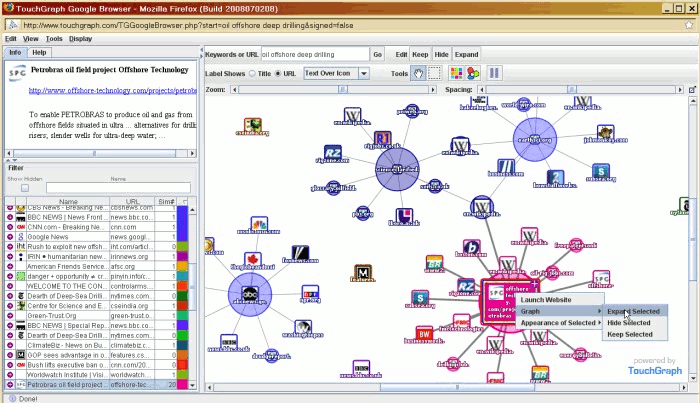
TouchGraph is a Java application that loads into your browser window and displays the networks and connections in your data or a search results list. There are three free demos that tie into Google, Amazon and Facebook. I found the last two very cumbersome to use and limited in their usefulness but the Google one is worth a try. You type in your keywords or a URL and Google's results are presented as groups of interconnected 'blobs'. You can zoom in and out, hide or expand individual groupings and filter results, although I must admit to not having yet mastered the last feature.
An interesting way to explore search results but I still prefer Cluuz's visualisation of web based data. I may find TouchGraph more useful for looking at connections and relationships within my locally held information so I have signed up for a TouchGraph Navigator trial.
TouchGraph is a Java application that loads into your browser window and displays the networks and connections in your data or a search results list. There are three free demos that tie into Google, Amazon and Facebook. I found the last two very cumbersome to use and limited in their usefulness but the Google one is worth a try. You type in your keywords or a URL and Google's results are presented as groups of interconnected 'blobs'. You can zoom in and out, hide or expand individual groupings and filter results, although I must admit to not having yet mastered the last feature.
An interesting way to explore search results but I still prefer Cluuz's visualisation of web based data. I may find TouchGraph more useful for looking at connections and relationships within my locally held information so I have signed up for a TouchGraph Navigator trial.
Labels:
Search Engines,
TouchGraph,
visualisation of results
Yahoo! drops Boolean NOT operator
I go away on holiday for three weeks and on my return disaster strikes. " Yahoo! drops Boolean support" was the headline that jumped out at me as I fired up my RSS reader. The story, carried by Pandia Search Engine News, refers to a report by Greg Notess in Online Magazine. I was not able to access the original in Online so had to make do with Pandia's summary and test out the claims myself.
It turns out that it is only the NOT operator that has vanished. Not such a catastrophe after all as you can still place a minus sign in front of the term that you want excluded from the search results. The posting goes on to say that nesting with parentheses has also been dumped. That was definitely not the case when I carried out test searches on both the UK and US versions of Yahoo. All of my nested Boolean searches worked, once I had replaced the NOTs with minus signs.
I shall wait a a week or so before assuming that the change is permanent. Earlier this year, the link and linkdomain commands went AWOL. They were no longer available on the main Yahoo sites but still worked on AltaVista. After a couple of days they reappeared on Yahoo as suddenly as they had vanished. Hopefully NOT will be back - it is easier to remember to use only Boolean operators rather than a mixture of Boolean and math signs - and fingers crossed that none of the other commands disappear.
It turns out that it is only the NOT operator that has vanished. Not such a catastrophe after all as you can still place a minus sign in front of the term that you want excluded from the search results. The posting goes on to say that nesting with parentheses has also been dumped. That was definitely not the case when I carried out test searches on both the UK and US versions of Yahoo. All of my nested Boolean searches worked, once I had replaced the NOTs with minus signs.
I shall wait a a week or so before assuming that the change is permanent. Earlier this year, the link and linkdomain commands went AWOL. They were no longer available on the main Yahoo sites but still worked on AltaVista. After a couple of days they reappeared on Yahoo as suddenly as they had vanished. Hopefully NOT will be back - it is easier to remember to use only Boolean operators rather than a mixture of Boolean and math signs - and fingers crossed that none of the other commands disappear.
Monday, 28 July 2008
Cuil not so cool
Cuil, pronounced 'cool', was launched today claiming to have the largest database of all the search engines and more relevant results. A detailed article on the company's background, together with a critique of its PR, can be found on Search Engine Land - Cuil Launches -- Can This Search Start-Up Really Best Google?
Cuil's index of 120 billion web pages might indeed make it the most comprehensive search engine on the web. Google no longer discloses the size of its index, although it claims to "know about a trillion unique web pages". Techcrunch has put Cuil through its paces (Google Beats Cuil Hands Down In Size And Relevance, But That Isn’t The Whole Story and says:
Many of Techcrunch's searches are single word searches and Google's hit count is never accurate for those and is usually grossly overestimated. Add in more terms and the hit count starts to approach reality. My test searches found approximately the same number of pages in both Cuil and Google, apart from those queries that had more than three terms. For example, my standard 'gin vodka sales UK' search came up with:
This is a simple search for which all of the other major search engines find a highly relevant answer from the Gin and Vodka Association (yes there really is one) . Reduce the number of keywords to a maximum of three and Cuil recovers but returns irrelevant results. It looks as though Cuil cannot cope with long search queries and this could be related to the way it ranks pages. It claims not to just catalog keywords on a site and then rank the site based on its importance; it also tries to understand how words are related. This seems to work best with one or two word queries. Results are shown in three columns and on the right hand side of the screen it offers options to refine your results by category. Apparently, Cuil also recommends related searches in tabs across the top of search results but I never saw these in any of my test searches.
So far I was not impressed and for me the final straw was the total absence of any advanced search features. No file format searching, no limiting to media types, no domain or site searching. I could be charitable and attribute the absence of results for multi term strategies to the service being new and not being able to cope with the traffic generated by the launch announcement. The relevance of the results from my test searches, though, was not sufficiently high for me to be able to dispense with advanced search. Cuil is going to have to try a lot harder if it is to persuade me to return. At present this is not a Google beater and neither does it out-perform the other top search engines.
P.S. Just as I finished this review the Cuil web site collapsed under the pressure. The home page now re-directs to:
Cuil's index of 120 billion web pages might indeed make it the most comprehensive search engine on the web. Google no longer discloses the size of its index, although it claims to "know about a trillion unique web pages". Techcrunch has put Cuil through its paces (Google Beats Cuil Hands Down In Size And Relevance, But That Isn’t The Whole Story and says:
"It seems pretty clear that Google’s index of web pages is significantly larger than Cuil’s unless we’re randomly choosing the wrong queries. Based on the queries above, Google is averaging nearly 10x the number of results of Cuil."
Many of Techcrunch's searches are single word searches and Google's hit count is never accurate for those and is usually grossly overestimated. Add in more terms and the hit count starts to approach reality. My test searches found approximately the same number of pages in both Cuil and Google, apart from those queries that had more than three terms. For example, my standard 'gin vodka sales UK' search came up with:
This is a simple search for which all of the other major search engines find a highly relevant answer from the Gin and Vodka Association (yes there really is one) . Reduce the number of keywords to a maximum of three and Cuil recovers but returns irrelevant results. It looks as though Cuil cannot cope with long search queries and this could be related to the way it ranks pages. It claims not to just catalog keywords on a site and then rank the site based on its importance; it also tries to understand how words are related. This seems to work best with one or two word queries. Results are shown in three columns and on the right hand side of the screen it offers options to refine your results by category. Apparently, Cuil also recommends related searches in tabs across the top of search results but I never saw these in any of my test searches.
So far I was not impressed and for me the final straw was the total absence of any advanced search features. No file format searching, no limiting to media types, no domain or site searching. I could be charitable and attribute the absence of results for multi term strategies to the service being new and not being able to cope with the traffic generated by the launch announcement. The relevance of the results from my test searches, though, was not sufficiently high for me to be able to dispense with advanced search. Cuil is going to have to try a lot harder if it is to persuade me to return. At present this is not a Google beater and neither does it out-perform the other top search engines.
P.S. Just as I finished this review the Cuil web site collapsed under the pressure. The home page now re-directs to:
"We’ll be back soon...
Due to overwhelming interest, our Cuil servers are running a bit hot right now. The search engine is momentarily unavailable as we add more capacity.
Thanks for your patience."
Sunday, 27 July 2008
Guernsey Registry
The new Guernsey Registry was launched on 1 July 2008 following a review of the Companies (Guernsey) Law and the existing company processes. The Registry also includes the Bailiwick of Guernsey Intellectual Property Office which administers all Trade Mark and Design registrations and activities, and provides information on the Intellectual Property Laws enacted in the Bailiwick. As well as providing e-filing services for companies, there is a searchable database. You can search by registered number or company name (current and previous). Company number, name, type, status, registered address, activity, and date registered are available free of charge. Company profiles, certificates of good standing and of incorporation are priced as are the annual reports. There is a link to the Companies (Guernsey) Law 2008, which can be downloaded free of charge. Be warned - it is 569 pages long!
Labels:
Business Information,
company registry,
Guernsey
Subscribe to:
Posts (Atom)