Showing posts with label UK. Show all posts

Tuesday, 30 January 2018

Brexit - sources of information

Please note: a regularly updated version of this posting is now on the main website at http://www.rba.co.uk/sources/brexit.htm 

Those of us living and working in the UK are constantly bombarded with news and information of varying quality on Brexit. I regularly run workshops on sources of business information and,  inevitably, these now include a section on the European Union (Withdrawal) Bill, commonly referred to as Brexit. One of the exercises I give those attending the workshop is to draw up their own individual list of resources that they are likely to use for keeping up to date, or as starting points for researching the topic. We then produce a combined list for the whole group.  I have listed below a selection of those resources, concentrating on the more general sources rather than industry specific sites that were mentioned in some of the sessions.  It is by no means a comprehensive list and this blog posting will not be updated,  but I have created a separate web page Brexit - UK withdrawal from the EU, which will be added to and amended periodically.

EU referendum results


Electoral Commission EU referendum results
The Electoral Commission is the independent body that oversees elections and regulates political finance in the UK. This page shows the voting totals and results by region and by area within that region. You can download the results data in full as a CSV file. There are also links to results visualisations, information on grants to designated lead campaigners, the Electoral Commissions assessment of the EU referendum question and their recommended amendment, and the voting guides.

EU Referendum Results - BBC News
The BBC referendum results page and linked pages presents the same information as the Electoral Commission but in a slightly different way. There are links to the BBC news stories and videos on and around the date of the referendum.

Results of the United Kingdom European Union membership referendum, 2016 - Wikipedia 
Another page showing the voting results in a variety of ways but in addition this one has links at the end to external sources reporting on the run up to the referendum and local press articles some of which show a breakdown of the results by ward.

News


Brexit: research and analysis - UK Parliament
"Research and analysis from Parliament's libraries and committees on how leaving the EU will affect different policy areas in the UK".
Brexit email alerts on updates and new content are available.

Brexit: All you need to know about the UK leaving the EU - BBC News
Background information on the what has happened so far, what is happening now, what has been agreed and what needs to be agreed. There is also a long list of FAQs (frequently asked questions), many of which cannot be answered yet but some possibilities are discussed.

The Guardian - Weekly Brexit Briefing
A very useful summary and update from The Guardian newspaper on what has been happening over the past week. You can sign up to receive the briefing by weekly email and there is also a weekly Brexit Means podcast.

General News Search

If you are interested in seeing articles that represent a wider range of viewpoints and opinions, run a search on Brexit in Google News and Bing News. As well as the national and regional UK papers, these will also pick up stories appearing in the press in other countries.

Legislation


European Union (Withdrawal) Bill 2017-19 - UK Parliament
Use this page to monitor the progress of the Bill through Parliament and see related documents such as:

  • Full text of the Bill as introduced and further versions of the Bill as it is reprinted to incorporate amendments (proposals for change) made during its passage through Parliament.

  • Tracked changes versions of the Bill

  • Explanatory Notes

  • Full list of amendment papers relating to the Bill.

  • Public Bill Committee and report stage proceedings

  • House of Commons Library and House of Lords Library briefing papers

  • Will write letters (Questions put to government Ministers during debates on Bills may be answered by the Minister saying 'I will write to the Hon Member'. “Will write” replies are not published in Hansard but are placed in the Library of the House concerned and published on the Parliamentary website.)
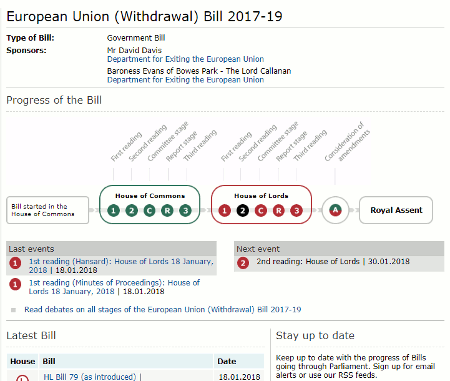


Alerts on changes to the page, stage reached by the Bill, and new documents are available by email and RSS.

Blog | UK Constitutional Law Association
Affiliated to the International Association of Constitutional Law. The UKCLA blog provides analysis and comment on matters of constitutional law in the UK. Not suprisingly, many of the current blog postings cover some aspect of the European Union (Withdrawal) Bill.

Jack of Kent blog
"News and comment on law and policy, from a liberal and critical perspective". Written by David Allen Green who is a legal commentator at FT.com and a former legal correspondent of the New Statesman. Currently posting mainly about Brexit.

Public Law for Everyone – Professor Mark Elliott
Another source of comment and analysis on the EU (Withdrawal) Bill. Written by Mark Elliott, Professor of Public Law at the University of Cambridge, a Fellow of St Catharine's College, Cambridge, and Legal Adviser to the House of Lords Select Committee on the Constitution. The views expressed on this blog are in a purely personal capacity.

Friday, 27 May 2016

Small companies now allowed to be bigger ... or smaller

One of the services I provide is company research including official registry documents and accounts. Many registries, including, the UK's Companies House, make a significant amount of their data available free of charge. Some still charge for documents and a few insist that you register before you can even search for a company.  If I know the information is freely available I usually point the client at the relevant website but a few people come back to me when they discover that the interface is in a foreign language. If registration and/or payment are required I'm often asked to search on the client's behalf because they just do not want the hassle of going through the registration process and recouping the cost of a small overseas transaction from their accounts department.

Regardless of whether the information is free or charged for, I often receive what I call a second stage request for more detailed accounts. Why is there no Profit & Loss? Where is the revenue/turnover figure? I then have to explain how the reporting and filing requirements differ depending on the country, or even state; and then I have the joy of taking the client through small company exemptions. Some people I know have only just got their head around the changes introduced by UK Companies Act 2006. I now have to tell them that this has changed yet again.

In March 2015 the UK Government approved new regulations that implement the requirements of the new EU Accounting Directive. The changes came into effect in the UK from 1 January 2016. There are a number of changes, which may reduce yet further the amount of information that small companies are required to provide, and there are also changes to what is deemed to a be a "small" company.  Small companies can now be bigger.

A company can now qualify as small if meets at least two of the three following criteria:

  • turnover not more than £10.2m (previously £6.5m)

  • balance sheet total not more than £5.1m (previously £3.26m)

  • average number of employees not more than 50 (no change)


Information on some of the other changes can be found on the Companies House Blog - Changes to accounting standards and regulations. The key ones are:

"... the removal of the ability for a small or medium-sized company to file abbreviated accounts with us at Companies House. A company will now be required to file the accounts they prepare for their members at Companies House (although a small company or micro-entity will usually be able to choose not to file their profit and loss account or director's report)."

"However, this does not mean that all small companies are now required to file full accounts, the very smallest companies may disclose less information by preparing micro-entity accounts. Other small companies may, instead of filing full accounts, choose to prepare a set of abridged accounts for their members and then file these with us."

So, as well as "small" being allowed to be bigger we now have even smaller companies or "micro-entities" who can choose to disclose less information. The whole thing is beginning to look as clear as mud!

The ICAEW has a useful overview of what is happening at The revised UK small companies regime but if you want to keep up with the latest updates then follow the Companies House Blog.

Wednesday, 30 March 2016

Debunking Euromyths

Those of us living in the UK have become accustomed to sensational headlines in the British press warning us that the European Union (EU) is about to ban British cucumbers, sausages, cheese, church bells, street acrobats [insert food or activity of your choice]. Tracking down the relevant EU legislation to find out whether or not there is any truth in the stories is a nightmare, and they are not the easiest of documents to read and understand when you do find them. But help is at hand from an EU blog called "European Commission in the UK – Euromyths and Letters to the Editor" at http://blogs.ec.europa.eu/ECintheUK/.

The blog covers scare stories that have appeared in the UK press, some of which go back to 1992, and explains what the situation really is and the relevant legislation.

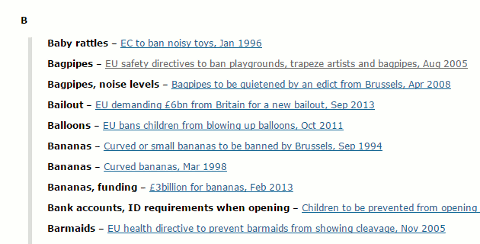
Euromyths A-Z

There is a neat A-Z index at   http://blogs.ec.europa.eu/ECintheUK/euromyths-a-z-index/ so you can quickly check, for example, if the EU is about to ban bagpipes:

"As for banning bagpipes, Scots can rest assured that their favourite musical instrument is not under threat from EU proposals on noise pollution ... they are designed primarily for those who work with loud machinery for a sustained period – more than 87 decibels for eight hours in a row. The law ... will apply only to workers rather than audiences.  If, in the highly unlikely event a bagpipe player is hired to play continuously for eight hours, and the noise created averaged more than 87 decibels, the employer would be obliged to carry out a risk assessment to see where changes can be made – tinkering with the acoustics in a hall to reduce echoes, for example. If that fails, personal protection such as earmuffs will need to be considered, but only as a last resort. Banning musical instruments is not an option. "


The blog is just one of many on the Europa website. A list can be found at Blogs of the European Commission.

Thursday, 4 December 2014

Turn2Us database of hardship grants

I came across Turn2Us  via the Paul Lewis Money blog (http://paullewismoney.blogspot.co.uk/2014/11/hardship-grants-available.html) where there is an excellent overview of the service. Turn2Us is part of the Elizabeth Finn Care charity. As well as providing a useful benefits search tool there is a searchable database of over 3000 charities that distribute £288 million in grants to individuals in financial hardship every year. To find potential sources of grants in your location type in your postcode, gender and age. Some of the charities only provide grants for people who have worked for a particular company or in a particular industry, but there are many that offer support to the general population and can help with education costs, living costs or hardship in retirement.

When I typed in my postcode (Reading), age and gender it came up with a list of 72 charities. There were some that were bizarre in their specificity. The Edmund Godson Charity, for example, offers "one-off grants for people in need who wish to emigrate and who currently live in and around Woolwich, Shinfield near Reading, north east Herefordshire and Tenbury in Worcestershire". I was also intrigued by one that provides grants and annuities for "older women in the UK who are not 'of the artisan class'", and was left wondering whether I would qualify.


Those idiosyncrasies aside, there is a wide range of help available here from charities that are little known and not easy to find.

Monday, 7 October 2013

Interactive maps of UK renewable energy generation

I recently mentioned Gridwatch (How the UK’s electricity is generated as a way of tracking how much energy is passing through the National Grid and the technology used to generate that electricity. Although Gridwatch is a great way of observing the total amount of electricity that is generated by each technology - gas, coal, wind etc - it does not go into any detail with respect to individual installations. The Digest of UK energy statistics (DUKES) produced by the UK  Department of Energy & Climate Change (http://www.gov.uk/government/organisations/department-of-energy-climate-change/series/digest-of-uk-energy-statistics-dukes) includes a spreadsheet listing all of the operational power stations, fuel that they use, installed capacity, location, and the year that generation began. The direct link to the spreadsheet is http://www.gov.uk/government/uploads/system/uploads/attachment_data/file/226895/dukes5_11.xls. This is historical data and the current list refers to plants in operation at the end of May 2013.

UK Energy Watch has a map (http://www.ukenergywatch.org/Electricity/PowerStations) showing the location of UK power stations of 400 MW or larger, so it is by no means comprehensive. It does allow you, though, to click on a plant and display current generation except for CCGT stations (Combined Cycle Gas Turbine).

There are more options available when it comes to what are called renewables (for example wind, solar, biomass, hydro). The DECC's RESTATS interactive map at http://restats.decc.gov.uk/app/pub/map/map/ enables you to search by technology, region, county, planning authority and application status. It also has a separate map for wind farm capacities.


The site information includes installed capacity, details of the planning application but not how much energy is actually being produced. RESTATS says that "Information is held on the performance of operational projects but owing to the need to maintain the commercially sensitive nature of these data, specific site details and performance figures are not disclosed".


The UK Data explorer has produced a renewables map at http://ukdataexplorer.com/renewables/ that uses the RESTATS data and shows operational renewable electricity sites over 0.01 MW. The different colours represent the type of plant and the area of the circles indicate installed capacity (maximum power output).


To see details of a specific installation you should be able to hover over a point on the map. This did not work for me with some of the smaller plants and when I tried to zoom in on an area I often lost the background map.

The Interactive Map of Renewable and Alternative Energy Projects in the UK at http://www.renewables-map.co.uk is another interactive map and can be filtered by technology type and planning status.


According to the website the information is gathered from "a wide range of web resources, in all cases these will be referenced, usually by a link to that information. Locations are either taken from existing data, usually from planning applications, or by painstakingly identifying the location on the ground using online maps." I am not sure how up to date the map is and I noticed that the smaller hydro installations along the Thames are missing. Another problem that I have experienced with this site is that when I click on "More details" for an installation I get far too many "internal sever errors". However, when the information does appear it includes useful comments on the technology, links to relevant websites and the latest news.


The final one in my list is from the energy generating company RWE Innogy (http://www.rwe.com/web/cms/en/194914/rwe-innogy/sites/production-data-live/). Its interactive map provides information on most of its European plants and includes wind farms, hydro power plants and biomass CHP (Combined Heat and Power). The production data is updated every minute. To see information on an installation, click on its icon on the map. The information includes live production, location, type of installation and when production started.


These are by no means the only websites offering interactive maps and information on UK energy production, and none of them give the full picture. They are good starting points, though, if you are interested in researching individual technologies or individual power stations.

Wednesday, 21 August 2013

How the UK's electricity is generated

Gas and electricity supply, and energy in general, are constantly in the headlines in the UK. Reports on the anti-fracking protests at Balcombe recently dominated discussions on the topic but the central issue remains. How do we meet our energy needs in the future: gas, coal, nuclear, renewables? Looking at the level of current consumption and how it is generated is key to understanding the nature of the problem. For electricity, there is detailed data available on the status of the UK National Grid and can now be viewed via a service called Gridwatch.

Gridwatch (http://www.gridwatch.templar.co.uk/index.php) shows the demand for electricity in the UK at any one time, the source and how it is being generated. The site is maintained by Templar Consultancy and uses near real-time data from BM Reports on what the UK's electricity grid is doing. The data is updated every 5 minutes.

The data is presented as a series of dials so that you can easily see how much energy is generated and how that changes throughout the day. Most of the screen is taken up with dials for demand, coal, nuclear, CCGT (gas) and wind.


The right hand area of the screen shows how much electricity is generated through pumped hydro, hydro, biomass and oil, and the level of imported electricity.


Move your cursor over a dial for further information on the different technologies and sources of generation. Coal and nuclear power stations are always switched on and provide most of what is called the base load of electricity required throughout the day. Gas makes up the difference and covers peak demand and balances the variable output from renewables such as wind.

Not much changes during the summer months but the demand can increase dramatically during very cold weather in the winter. It is interesting to see how the dials shift as soon as people get up in the morning. Also, the amount of electricity produced via wind turbines drops to almost zero during stormy weather. The turbines are switched off in high winds to protect them from damage.

Warning: this site can be addictive, especially if you start monitoring it during late autumn and winter!

For more data and statistics on UK energy go to the Department of Energy and Climate Change (DECC) at https://www.gov.uk/government/organisations/department-of-energy-climate-change/about/statistics

Wednesday, 12 June 2013

Company Check: free UK company and director information

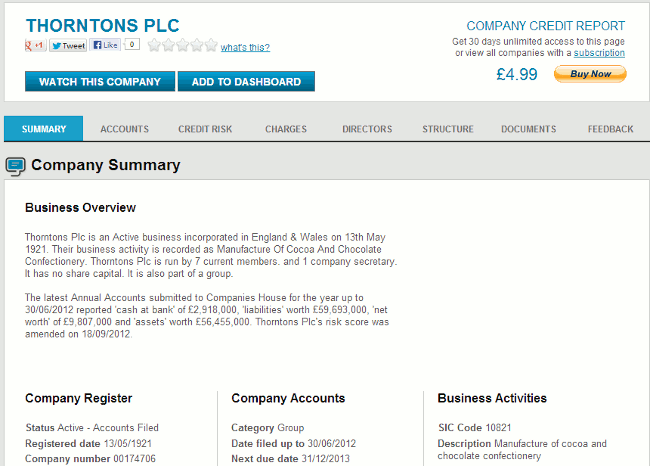
Company Check (http://companycheck.co.uk/) and its sister website Company Director Check are two of the more popular services on my business and search workshops. They repackage official information from Companies House and provide much of it free of charge. I first reviewed them in 2011 (http://www.rba.co.uk/wordpress/2011/07/20/company-information-company-check-gives-more-uk-data-for-free/ and http://www.rba.co.uk/wordpress/2011/11/14/free-uk-company-information-company-director-check/) and since then there have been many updates and additions. A recent change is that company and director information have been pulled together on the Company Check website making it easier to flip between companies and directors. Data on companies in Ireland is also now available.

Companies and directors can be searched from the same search box. You then select the appropriate entry from a list of possible matches. The company summary is free of charge and includes a business overview, data on its status and business activities, and a list of trading addresses.


Also free of charge are the accounts and list of directors but you have to register (free of charge) to view the information. There are options for logging in with your Facebook, Twitter or Google account but if you prefer you can register a user name and password.

Five years of key financials (cash at bank, net worth, total current liabilities and total current assets) are shown as graphs and more detailed information is displayed in the Company Accounts Table.


 The financial statements submitted to Companies House can be downloaded free of charge as PDFs. Other documents lodged at Companies House such as "Change of director's details" or "Allotment of securities" are listed under the Documents tab and are £2 each.

The Credit Risk information (risk score, credit limit, payment data and key factors) and Charges (mortgages and County Court Judgments) are priced. For a single company the price is £4.99 + VAT, which gives you 30 days unlimited access to all premium credit data on that company for 30 days. If you are likely to be researching more than four companies on a regular basis it is worth upgrading to the All Companies options costing £20 + VAT. This gives you 30 days unlimited access to credit data across every company and director.

Current directors and secretaries for a company are listed free of charge. Previous directors and secretaries are part of the subscription service. The free director profile includes an overview, their registered details and a summary of the companies of which they are or have been a director. This can be more informative as a way of identifying connections between companies and other directors than looking at the company records in isolation. The full director report reports are £8.99 and include credit risk, CCJs, mortgages and charges, and a summary for each current appointment with key information taken from the associated company report.


For both companies and directors you can set up free alerts and add them to a dashboard. This is an easy way to compare results for companies, with negative and positive changes in key financials shown as red or green arrows pointing up or down.


Company Check is not the only service providing free access to some of UK Companies House and Ireland company data. DueDil (http://www.duedil.com/) and Bizzy (http://bizzy.co.uk) are two others that are worth looking at. I understand, though, that Company Check  is working on additional services that are due for launch in the next few months. It will be interesting to see what they come up with.

Sunday, 26 August 2012

Doing Business in the United Kingdom and France

Compiled and published by Bryan Cave LLP, Doing Business in the UK is an excellent summary of what is involved in setting up a business in the UK and the associated legislation. As well as describing the various types of company it also covers director's duties, UK taxation, employment law, business immigration, intellectual property, data protection and competition law. There is a similar publication on Doing Business in France. Both are free of charge.

Monday, 16 July 2012

Google maps UK canals

First cycle routes and now canals. Google is collaborating with the Canal and River Trust to provide a Google Map guide to the UK's canal network called In Your Area (http://canalrivertrust.org.uk/in-your-area). It is not available as part of the standard Google Maps. The map allows you to enter your address or postcode to find the nearest canal. The map shows the locations of canals, canal locks and bridges and also volunteering opportunities, places to eat and drink and boating services and moorings.


It is early days and not everything is marked up on the map, or at least it isn't for the Kennet and Avon Canal in Reading. Also planned for later this year is the addition of  'Street View' images of the canal and river network. (Please, no lurking in the bushes by the side of the tow paths and pushing the Google cycles into the canal!)

Friday, 13 July 2012

Google adds cycling routes to UK maps

Google has added cycle routes and directions to its UK maps. The feature has been available on US and Canadian maps since 2010 but has now been extended to the Europe and Australia. In the UK Google has been working with Sustrans (http://www.sustrans.org.uk/) to include bike trails, lanes and recommended roads. Set your starting point and destination as usual and the directions area on the screen should include a bicycle icon in addition to the car, public transport and walking icons.


Select a suggested route and as well as text instructions it will be outlined in blue on the map. The "bicycling layer" also shows trails (dark green lines), dedicated lanes (light green lines) and bicycle friendly roads (dotted green lines). Google came up with two routes from my house to Reading Railway Station. The first more direct one followed the roads.


The second suggestion took the scenic route along the river, which would be more pleasant and probably safer during the rush hour.


The directions come with the usual warning that they are in beta and that you should use caution. There is an option to report unmapped bike routes, streets that aren't suited for cycling, and other problems.

Further information is available on Google Lat Long: Biking directions expands into Europe and Australia (http://google-latlong.blogspot.co.uk/2012/07/biking-directions-expands-into-europe.html. The Guardian Bike Blog has tested out a couple of routes in London (Google Maps' cycle routes: just how good are they?  http://www.guardian.co.uk/environment/bike-blog/2012/jul/12/google-maps-uk-cycle-routes?) and set up a Twitter hashtag #cycletest for cyclists to comment on the routes they have tried.

Saturday, 7 January 2012

Google Transit takes the scenic route

I travel a lot for both business and leisure and I use public transport whenever possible. The plus side to this is that if it is a longish journey - for example Reading to Manchester - I can settle down on the train and get on with some work. The down side is that I have to know my way around the transport networks, not just in the UK but also in the other countries I visit.

After over 20 years of business travel I have a range of tools and timetables bookmarked on my laptop plus the really useful stuff inside my head gained from experience. For example, the easiest route is not always the quickest: a single cross country stopping train may take longer but the seemingly quicker alternative of three changes can be seriously stress inducing and take longer if there are delays, signals failures, "incidents" and you miss your connections.

I recently spotted that two of my clients link to Google Transit (http://www.google.com/transit) on their map and directions pages so I thought I would give it a go. You do not have to go to the Google Transit page to start using this; if you are already on Google Maps and are looking for directions from A to B, choose the middle "By public transport" icon. So let's try a journey from Reading railway station to Milton Keynes.


Well I didn't expect that: a 3 hour journey using 3 buses. Running the journey through the Google Transit page itself the journey time increases to around 3.5 hours and the number of buses to 4.


Google is well known for giving different results for the same type of search depending on the route you take but I was perplexed by Google's insistence that I have to travel by bus. OK, it's Saturday so there are probably engineering works and buses are probably the best option. I checked the National Rail web site (http://www.nationalrail.co.uk/):


No problem it seems. My train journey via London would take just under 2 hours. Perhaps bus transport is Google's default option? Underneath the 'B' location is 'Add Destination - Show options'. Click on this and from the 'Prefer' box you can choose Any mode of public transport, Bus, Underground, Train, Tram/Light rail. The box underneath offers Best route (no definition as to what 'best' means), Fewer transfers, Less walking. No matter what combination of options I selected Google insisted that bus is the only option.


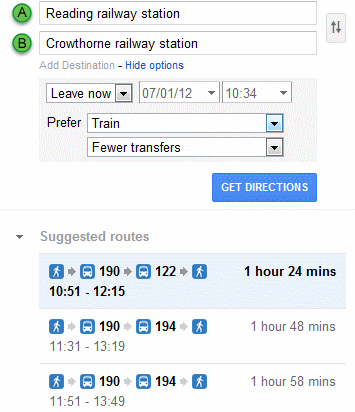
Perhaps Google is confused by the cross-London element of my journey even though Underground is one of the 'Prefer' options. Let's look at a simpler journey: Reading to Crowthorne. I frequently travel along this route and it is a straightforward journey by rail taking 14 minutes as confirmed by National rail.


Google, however, insists that it requires two buses and 1.5-2 hours!


I tried other routes and it seems that Google, in the UK at least, thinks that public transport means bus despite the 'Prefer' options it offers. This could be useful, though, if there is a rail strike and you need to identify alternative means of transport. Or you could go straight to Traveline (http://traveline.info/).

Friday, 30 December 2011

Google shows postcode boundaries - sort of

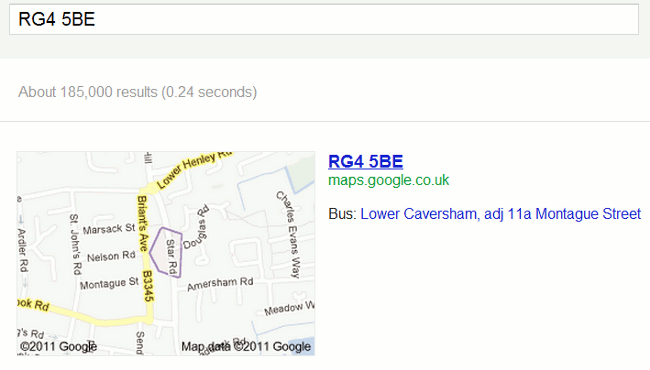
Google has started showing UK postcode area boundaries but not in Google maps as one would expect. Using the standard Google search box type in your postcode and at the top of your results Google shows you a map with the boundaries of the postcode area.


Although the boundaries are in roughly the right area, they are not accurate. In this example, the coverage of RG4 5BE extends north and south to the top and bottom of Star Road. Others have reported similar discrepancies in their areas. As a general indication of the location of a postcode area it is fine but do not rely on Google to identify which streets or parts of streets are covered by it. Google also gives information on the nearest bus stop, which in this case is correct but not the only option. If you click through to the full sized Google map the boundaries disappear and they do not appear at all if you do the search straight away within Google Maps. You do, though, see more information on the public transport options.


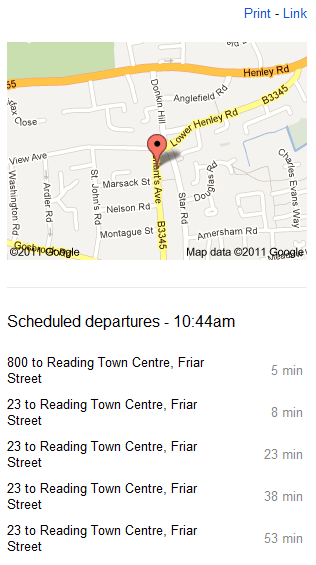
Alternative bus stops are given and the numbered routes listed. I was rather puzzled by the number 74 and 74 A, which  have never seen, but a quick check revealed that it is the "football" bus that runs once a day and only when there is a match at the Madjeski Stadium. The scheduled times for the next buses are as accurate as the bus company timetables provided via Traveline and Transportdirect. I watched three buses arrive and compared it to Google's schedule: the number 800 was 7 minutes late, the first number 23 was 6 minutes late and the second on time so Google is not using real time data.

Overall, it's not bad. Just remember that the postcode boundaries are approximate so if you need something more precise use the Royal Mail web site. The bus timetable will not tell you if a bus is delayed or cancelled but if you are contemplating moving to the area it is a quick way of assessing how good (or bad) the local public transport is.

Monday, 14 November 2011

Free UK company information: Company Director Check

Company Director Check (http://company-director-check.co.uk/) is a sister database to Company Check (http://companycheck.co.uk/), which I reviewed earlier this year (http://www.rba.co.uk/wordpress/2011/01/10/free-uk-company-information/). It provides free access to information on current and past directors of UK companies that until now has only been available for a fee. Director searches can unearth links between apparently unrelated companies and help you identify "families" or groups of companies. It can also bring to light interesting patterns of behaviour. For example, I carried out a search on a director whose business activities had aroused my suspicions. I knew he had run companies in the past that had been dissolved and his most recent venture had gone into liquidation. Looking at the list of companies of which he had been director it became clear that 6-8 weeks before a company was dissolved or went under he would set up a completely new company. This had happened so often that it was not just me who had begun to smell a rather large rodent. I understand that he is "currently under investigation"!

If you are viewing a company in Company Check click on the director's name and you are taken straight to their record in Director Check. Alternatively just run a search on the person's name in Director Check. A list of possible matches will be presented to you, which you can refine by entering a postcode. Alternatively just work through the list until you are certain that you have found the correct person. Do not be surprised if you find a director has multiple IDs. There is nothing "dodgy" about this, it just reflects the way the system has evolved over the years. Companies House have carried out a massive exercise to try and fix this but there are still some multiple IDs in the database.

The information that is provided includes full name, short name, month and year of birth, address and past and present directorships.


The status of each directorship - active, dissolved, resigned - is displayed followed by a summary of each of the companies. More detailed information on the individual companies can be found on the Company Check web site.

Now that so much directorship information is freely available it will be interesting to see if more directors make use of the option to provide a service rather than their home address for the public record.

Definitely one to add to your business research toolkit.

Wednesday, 20 July 2011

Company Information: Company Check gives more UK data for free

I first reviewed Company Check (http://www.companycheck.co.uk/) earlier this year (Free UK company information http://www.rba.co.uk/wordpress/2011/01/10/free-uk-company-information/). Since then they have made more UK company information available free of charge. As well as Cash at Bank the service also shows 6 years of figures and graphs for Net Worth, Total Liabilities and Total Current Liabilities. Data is taken from official Companies House documents. Documents can be purchased through UK Data (http://ukdata.com/) but they are much more expensive than ordering direct from Companies House (http://www.companieshouse.gov.uk/) or bizzy (http://bizzy.co.uk/). UK Data's detailed credit reports are worth considering though if you want more in depth analysis. Although Company Check lists the company directors it does not show other directorships as does bizzy. (See my previous posting Company information: Bizzy for UK company data and credit ratings http://www.rba.co.uk/wordpress/2011/07/19/company-information-bizzy-for-uk-company-data-and-credit-ratings/). This is another very useful site that I recommend you add to your company information toolkit.

Tuesday, 19 July 2011

Company information: Bizzy for UK company data and credit ratings

There are numerous services that take UK Companies House data and repackage it. Some of the data is offered free of charge but more detailed information and additional analysis such as credit reports are priced. bizzy (http://www.bizzy.co.uk/) is one such organisation but uniquely it also offers free credit ratings for many UK limited companies. (Note that it is the overall rating and not the full report that is available free of charge.)

To search bizzy simply enter the name of a company and bizzy presents you with a list of likely matches. Click on the company you want to view and as well as documents available for purchase you can see free of charge the names of the directors together with a list of the other companies of which they are directors, industry sector, date of incorporation, registered address, and a list of competitors and peers.


To see the credit rating of the company you have to register with the site. Ordinary registration is free but there is also a bizzy PLUS account (£9.99/month or £99/year). The PLUS account allows you to view credit limits, mortgages and CCJs, includes a Risk Tracker for monitoring companies of interest, and gives you a 15% discount on all purchases. If you have the bizzy FREE account you will only be able to see credit ratings that are from 100 down to 30. Those below 30 show "Not public for this company" for their credit rating. If you have signed up for the bizzy PLUS all credit ratings are displayed.

The bizzy credit scores are as follows:
 85 and 100 - 'Excellent Creditworthiness',
70 and 84  - 'Very Good Creditworthiness'
50 and 69  - 'Good Creditworthiness'
30 and 49  -  'Creditworthy'
15 and 29  -  'Credit Against Collateral'
0 and 14 -  'Caution - Credit At Your Discretion'

I ran a check on a company for a friend of mine. They had heard rumours about the company and were uncertain as to whether it was safe to do business with them. Would the company go under? There was little to go on at Companies House as the company was filing abbreviated accounts and had not filed documents for the previous year. I used bizzy FREE to run the search and no credit rating was displayed. In order to see how bad it was I bought the credit report (£11.99). bizzy gave the company a rating of zero and the long list of outstanding CCJs for unpaid bills was all the evidence we needed to avoid the company like the plague. (The company concerned has now gone into liquidation).

Official documents filed at Companies House and bought direct from them cost £1 but can be bought via bizzy for £0.99. That is only 1 pence less than the Companies House price and might not be enough on its own to tempt you onto bizzy but the additional free information might. An important part of company research is uncovering what the directors are up to and bizzy makes it very easy to view a list of directorships held by a person. On the Companies House web site this is only possible if you subscribe to the full service rather than the free Webcheck option.

I have found that the information on bizzy is often more up to date than that provided by some of the larger credit rating companies and bizzy covers every UK limited company, even very small ones. I tried searching for three small companies using http://www.do-business.net/sbc, which I have often used in the past, and none of them were in the database.

Bizzy also searches official information and sells credit reports on companies in other European countries. It is not obvious how you do this until you start searching on the company name. Above and to the right of the list of companies on the results page is a 'Search Country' box and it is from the drop down menu that you select the country.


Remember, though, that the amount of information that companies have to disclose varies from country to country and may consist of little more than name, registration number, status and address.

If you are researching UK companies I recommend that you consider including bizzy in your toolkit, but should you go for a FREE or PLUS account? It all depends on how much company research you think you'll do in a year. If it is just a handful then perhaps the free option will suffice but more than that and bizzy PLUS with its 15% discount and standard display of credit limits, mortgages, and CCJs makes more economic sense.

Monday, 10 January 2011

Free UK company information

One of the most frequently asked questions that land in my inbox is "Where can I find information on [insert company name of your choice]". The enquiry is often about a UK company and comes from ordinary Joe or Josephine Bloggs who knows nothing about sources of business information. Those of you who, like me, have these resources at our fingertips may roll your eyes heavenwards but let's heave a huge sigh of relief that these people are bothering to ask about checking up on a company. On further investigation, many of my correspondents admit that they have been approached over the phone regarding a "once only opportunity" involving the company concerned and are suspicious of the offer. Unfortunately, I also receive emails from people wanting to find out about a company after they have parted with their money.

The first port of call for official information on UK companies is Companies House (http://www.companieshouse.gov.uk/). Not every form of company or organisation is required to register at Companies House: for example, in the UK I am a sole trader and therefore do not have to register or file accounts. I have noticed an increasing number of comments on the web and social media from small businesses who have decided to de-register because of  the bureaucracy. The absence of a registration at Companies House is not necessarily cause for concern but then most of us do not cold call people with an "exclusive investment opportunity"! An easy way to check if there is a problem with a company of any sort is to search for them on Google and include scam or hoax in your search. That may seem obvious but so many victims who contact me never considered that strategy.

So if you have been approached by the likes of Trotters Independent Traders ltd. plc go to Companies House and use the free Web Check option which is in the centre panel on the home page.


You can search for currently or recently dissolved names, dissolved names, previous names or proposed names. Free information includes name, registered number and address, status (for example active, liquidation), nature of business, date of last accounts. Further information and documents such as accounts and certificate of incorporation are priced at GBP 1 each.

Several other services re-package and sell information from Companies House and in some cases provide some of the additional priced Companies House information free of charge.

Company Check (http://www.companycheck.co.uk/) are part of  UK Data (http://ukdata.com/), which re-sells Companies House documents and provides credit reports. The latter include current and historical credit risk information, director details, ownership and group structure, CCJ information and up to five years of accounting figures including turnover and a profit and loss account if filed. All documents cost GBP 18, which is far more than that charged by Companies House but the credit report may be the better option if you need a detailed report and assessment of the company.

The Company Check free information includes name, registered address and number, telephone number, activity, status, thumbnail of the web site and cash at bank for the last five years. There is also a graph showing the number of website visitors from Compete (http://www.compete.com/), but this information may not be available for smaller companies.


Another source of free company information is the SME Hub Company Accounts Information (http://www.thesmehub.com/benefit/accounts). This is available to SME members only but registration is free. The company address is not displayed but there is a link that takes you to Companies House where you have to re-enter the company name to access the data. There is also a link to Credit Safe for credit reports (http://www.creditsafe.com/).


There is a very useful graph showing trends for the company in net worth, cash and total liabilities. The most recent accounts plus a downloadable PDF are also free of charge.

I had problems with the SME Hub when looking at companies that had recently gone into liquidation. Company Check gives its standard information plus the status as "Liquidation" but the SME Hub leaves you guessing by presenting you with an empty template.

Company Check and the SME Hub are quick and easy ways to access the free and some of the priced Companies House information. Company Check offers the Companies House free registration data and five years of cash at bank: the SME Hub provides a trends graph of net worth, cash and liabilities plus latest accounts but no basic contact or status information. Both can alert you to potential problems with a company but, ultimately, Companies House is the place to go for the original data.

Saturday, 3 April 2010

UK National Archives on Flickr

The UK's National Archives have added over 200 of their photos to their Flickr photostream. They can be found at http://www.flickr.com/photos/nationalarchives/. It is an interesting mix including Maps and Plans, Historical Documents, 19th and 20th century photographs, and 23 photographs taken by Felice Beato on the expedition for the relief of Khartoum in Sudan. There have already been comments about spelling mistakes and inconsistencies  in some of the photograph descriptions but National Archives have explained that they have reproduced exactly the photographers' own notes if available. The tags added to the photos by National archives do have the modern spellings.


The photos have "no known copyright restrictions":

"The National Archives is unaware of any current copyright restrictions on these images either because they are Crown Copyright and the copyright is waived or the term of copyright has expired. All of the images may be subject to other third party rights, such as rights of privacy. You are responsible for obtaining other such necessary permissions for reuse"

The images may be downloaded and reused without permission in any format for purposes of research, private study or education (non-commercial use) only. You are also asked to credit 'The National Archives' and include the catalogue reference of the item to allow others to access the original image or document.

Thursday, 11 March 2010

Google Street View covers most of UK

Google Street View now covers most of the UK. When I last looked at Caversham and Reading on March 9th they were not covered. Today they are! Looking at various pieces of evidence - for-sale signs, new buildings or lack of them, and the progress of exterior refurbishment - the photos in my part of Caversham were taken about 15 months ago.

Google Maps has yet to tell UK users to get on their bike, though. We currently have directions for travelling between two locations on foot and by car but in the United States there are now cycling directions for 150 cities. Those of us in the UK do not have "public transit" directions on Google Maps either but we do have http://www.transportdirect.info/, which I notice now has a cycle planner for selected areas. This is the first version of the planner produced in conjunction with Cycling England, Ordnance Survey and relevant local authorities. Transport Direct is looking for feedback from users so if you regularly cycle, and your area is covered, give it a go at http://www.transportdirect.info/Web2/JourneyPlanning/FindCycleInput.aspx

Thursday, 14 January 2010

Potholes.co.uk

The snow has started to clear in Caversham and the lower half of the road on Donkin Hill looks as though it has been repeatedly bombed. Major cracks, huge potholes and an alarming amount of subsidence are now in evidence. It is a scene that is going to be repeated over the whole of the UK in the next few days as the snow and ice retreat to reveal the damage caused by the freezing weather. I shall be out with my camera and reporting the state of the road to the council via FixMyStreet (see my earlier posting on this excellent service). I am sure our local Council will be inundated with similar reports from around Reading.

Potholes.co.uk is run by Warranty Direct who specialise in used car warranty, new car warranty and extended warranty. It is a "Campaign website to highlight poor state of British roads and help motorists seek compensation from Councils". Type in the first part of a postcode or the name of a town to view a Google map showing the location of any potholes in the area. Click on a marker to see a more detailed description of the problem.


To report a pothole you need to register and sign in. First enter a title and description and then the street name and town. A Google map should appear with a marker and you can then drag the marker to the exact location of the pothole(s). You can also upload a photo. Once you have submitted your report you are taken to a page where you are encouraged to report the problem to the local council.

There is a blog at http://www.potholes.co.uk/oursays where they talk about pothole issues and highlight news stories. Potholes.co.uk is also on Twitter at http://twitter.com/potholesuk/

I am not sure how useful this site really is for motorists as it is dependent on people reporting potholes to the web site, so it is not comprehensive. It is also not clear who marks the potholes as filled when the repairs are made. Feedback on both of those points would be welcomed.

Thanks to @cllrdaisybenson for the tweet that alerted me to the site.

Thursday, 9 July 2009

UK Mobile Phone Directory

Update: February 4th, 2010. This directory is no longer available


UK mobile phone numbers are now available in an online directory at http://www.118800.co.uk/, which claims to have 15m numbers in its database. 118 800 obtains the numbers from market research companies who contact individuals and ask if they would be prepared to allow their numbers to be used for commercial purposes, from online businesses who ask customers to opt in their numbers during the course of online transactions, and from brokers who buy and sell lists of phone numbers. To search for a number you just type the name and location of the person into the 118800 website. You may be asked to supply further address details to confirm the identity of the person you wish to contact. 118800 then texts the person you wish to contact asking them if they are prepared to accept the call. The service costs £1.

There have been serious concerns raised about this service and its potential use by spammers, and also about the accuracy of the data. See the BBC web site at http://news.bbc.co.uk/1/hi/programmes/working_lunch/8091621.stm and also 118 800: First UK mobile phone directory doesn't connect with us - Crave at CNET UK

If you wish to be ex-directory, go to http://www.118800.co.uk/ then click on ‘Ex Directory’ at top right hand side of the page. You will be asked for your mobile number and to type in letters from a CAPTCHA (those horrible distorted letters and numbers that take at least three attempts before you get it right). You should then receive a text message from 118 800 with a number that you have to type into the 118 800 web site to complete your opt-out. The FAQ says that it can take up to 4 weeks to make you ex-directory (why so long?)

Thanks to Bert Washington, membership secretary of CLSIG (Commercial Legal and Scientific Information Group), for circulating a reminder about the directory.