Slides can be viewed on Slideshare or authorSTREAM.
News and comments on developments in search and electronic resources. Once posted, the articles are not updated. Older postings may contain links that are out of date or no longer work.
Friday, 1 June 2018
Presentation: free search tools for research information
Slides can be viewed on Slideshare or authorSTREAM.
Saturday, 26 May 2018
Somebody, please put Google News out of its misery
In the latest incarnation, Google News has lost most of my topics, the "For You" is total rubbish as is "Local", you can no longer manage and personalise the topics (although that didn't really work anyway), and the RSS feed buttons have gone. I can only assume that this is all down to the real time AI/ML that Google recently announced was going to be used to organize the news. (The new Google News: AI meets human intelligence ).
Existing RSS feeds still work, though and you can create email alerts for a news search if you run it from within the general Google results page. Run your search in "All" and then click on the News link. There is a Create Alert button at the bottom of your results, but one wonders how long that will last.
Someone should put Google News out of its misery, close it down and leave news searchable via the link on the main page.
And they may as well ditch Google Finance as well. That is a shadow of its former self : no more portfolios for monitoring stocks, no more historical data for viewing and download, no more news annotations on the price charts, and the comparison option only works for two stocks at a time. If you are interested in monitoring the stock markets or researching individual companies for free get thee hence to Yahoo! Finance (https://uk.finance.yahoo.com/). There was some doubt over the future of Yahoo! Finance when Yahoo! was acquired by Verizon and became part of Oath but, charting oddities aside, there does seem to be some development going on. The new “Sustainability” tab for example shows environment, social and governance (ESG) ratings from Sustainalytics (https://www.sustainalytics.com/). There was positive feedback on it from some business librarians who attended one of my recent workshops.
So many of Google's services are going from bad to worse to totally pointless and unusable. No wonder, then, that people are starting to look seriously at alternative resources.
Monday, 23 April 2018
SmugMug buys Flickr - should we stay or should we go?
So the wait is over. When it was announced that Verizon was to buy Yahoo! there was concern as to what was going to happen to Flickr. Yahoo! never did much in terms of developing Flickr and what it did do was rubbish. Trying to add the location of your photo is an interesting experience at the best of times. You might be able to pin it onto the map but the name of the place is all too often wrong. I used to spend half my time on Flickr manually changing the location - not something to be taken on lightly - but I generally don't bother now. It's not worth the effort.
Then there are the auto generated tags that Flickr adds to your photos without asking for confirmation. (Flickr pulls out all the stops with automatic tagging). These are sometimes relevant and it is helpful to be reminded of tags that might prove useful when searching, but the error rate is far too high to leave Flickr to its own devices when generating these. Deleting the oddballs after you have uploaded individual photos is not too onerous but checking a back catalogue of thousands of photos for rogue tags is not really feasible. It explains why Flickr search results often include photos that no way match your search terms.
It would also be nice if we could have interfaces with social media and mobile apps that actually work.
And finally, many of us are looking forward to not having to use a Yahoo! account to log in.
Unfortunately, the email that is hitting subscribers inboxes right now states:
"Nothing will change immediately with regard to your Flickr account. You will still access Flickr with your current login credentials and you will have the same Flickr experience as you do now."
They do, though, go on to say:
"We will continue to work to make your Flickr experience even better."
Hmm. We shall just have to see if that is going to work out. In the meantime we have until May 25th, 2018 to decide if we want our Flickr account and data transferred to SmugMug. If we don't:
"you must go to your Flickr account to download the photos and videos you want to keep, then delete your account from your Account Settings by May 25, 2018. If you do not delete your account by May 25, 2018, your Flickr account and data will transfer to SmugMug and will be governed by SmugMug’s Terms and Privacy Policy".
So there we have it. I shall stay with Flickr/SmugMug for the time being and see how things develop. In any case, I shall be backing up my Flickr photos as usual just in case something goes seriously awry.
Tuesday, 30 January 2018
Brexit - sources of information
Those of us living and working in the UK are constantly bombarded with news and information of varying quality on Brexit. I regularly run workshops on sources of business information and, inevitably, these now include a section on the European Union (Withdrawal) Bill, commonly referred to as Brexit. One of the exercises I give those attending the workshop is to draw up their own individual list of resources that they are likely to use for keeping up to date, or as starting points for researching the topic. We then produce a combined list for the whole group. I have listed below a selection of those resources, concentrating on the more general sources rather than industry specific sites that were mentioned in some of the sessions. It is by no means a comprehensive list and this blog posting will not be updated, but I have created a separate web page Brexit - UK withdrawal from the EU, which will be added to and amended periodically.
EU referendum results
Electoral Commission EU referendum results
The Electoral Commission is the independent body that oversees elections and regulates political finance in the UK. This page shows the voting totals and results by region and by area within that region. You can download the results data in full as a CSV file. There are also links to results visualisations, information on grants to designated lead campaigners, the Electoral Commissions assessment of the EU referendum question and their recommended amendment, and the voting guides.
EU Referendum Results - BBC News
The BBC referendum results page and linked pages presents the same information as the Electoral Commission but in a slightly different way. There are links to the BBC news stories and videos on and around the date of the referendum.
Results of the United Kingdom European Union membership referendum, 2016 - Wikipedia
Another page showing the voting results in a variety of ways but in addition this one has links at the end to external sources reporting on the run up to the referendum and local press articles some of which show a breakdown of the results by ward.
News
Brexit: research and analysis - UK Parliament
"Research and analysis from Parliament's libraries and committees on how leaving the EU will affect different policy areas in the UK".
Brexit email alerts on updates and new content are available.
Brexit: All you need to know about the UK leaving the EU - BBC News
Background information on the what has happened so far, what is happening now, what has been agreed and what needs to be agreed. There is also a long list of FAQs (frequently asked questions), many of which cannot be answered yet but some possibilities are discussed.
The Guardian - Weekly Brexit Briefing
A very useful summary and update from The Guardian newspaper on what has been happening over the past week. You can sign up to receive the briefing by weekly email and there is also a weekly Brexit Means podcast.
General News Search
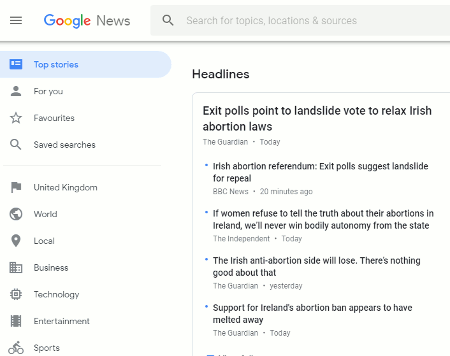
If you are interested in seeing articles that represent a wider range of viewpoints and opinions, run a search on Brexit in Google News and Bing News. As well as the national and regional UK papers, these will also pick up stories appearing in the press in other countries.
Legislation
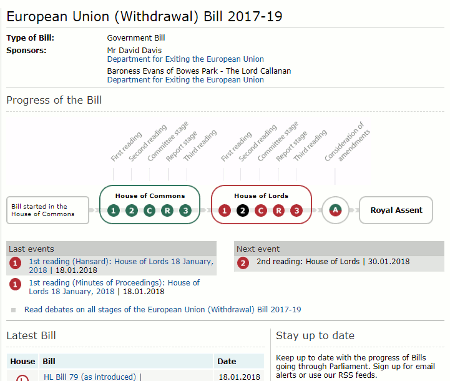
European Union (Withdrawal) Bill 2017-19 - UK Parliament
Use this page to monitor the progress of the Bill through Parliament and see related documents such as:
- Full text of the Bill as introduced and further versions of the Bill as it is reprinted to incorporate amendments (proposals for change) made during its passage through Parliament.
- Tracked changes versions of the Bill
- Explanatory Notes
- Full list of amendment papers relating to the Bill.
- Public Bill Committee and report stage proceedings
- House of Commons Library and House of Lords Library briefing papers
- Will write letters (Questions put to government Ministers during debates on Bills may be answered by the Minister saying 'I will write to the Hon Member'. “Will write” replies are not published in Hansard but are placed in the Library of the House concerned and published on the Parliamentary website.)
Alerts on changes to the page, stage reached by the Bill, and new documents are available by email and RSS.
Blog | UK Constitutional Law Association
Affiliated to the International Association of Constitutional Law. The UKCLA blog provides analysis and comment on matters of constitutional law in the UK. Not suprisingly, many of the current blog postings cover some aspect of the European Union (Withdrawal) Bill.
Jack of Kent blog
"News and comment on law and policy, from a liberal and critical perspective". Written by David Allen Green who is a legal commentator at FT.com and a former legal correspondent of the New Statesman. Currently posting mainly about Brexit.
Public Law for Everyone – Professor Mark Elliott
Another source of comment and analysis on the EU (Withdrawal) Bill. Written by Mark Elliott, Professor of Public Law at the University of Cambridge, a Fellow of St Catharine's College, Cambridge, and Legal Adviser to the House of Lords Select Committee on the Constitution. The views expressed on this blog are in a purely personal capacity.
Sunday, 29 October 2017
Google makes it harder to change location for country specific research
The problems start if you are researching a person, company or industry based in a country other than your own - let's use Norway as an example - or just want the latest news from that country. The trick used to be to go to the relevant country version of Google, in this case www.google.no, run your search and Google would give preference to Norwegian content. It is a great way to get alternative viewpoints on a topic and more relevant "local" information on a subject. Now, regardless of which version of Google you go to, you will see the same results tailored for your home location.
In a blog posting Making search results more local and relevant Google says:
Today, we’ve updated the way we label country services on the mobile web, the Google app for iOS, and desktop Search and Maps. Now the choice of country service will no longer be indicated by domain. Instead, by default, you’ll be served the country service that corresponds to your location. So if you live in Australia, you’ll automatically receive the country service for Australia, but when you travel to New Zealand, your results will switch automatically to the country service for New Zealand. Upon return to Australia, you will seamlessly revert back to the Australian country service.
This confirms that mobile search is what Google is concentrating on. After all it is, one assumes, where Google makes most of its money but it does not help professional researchers.
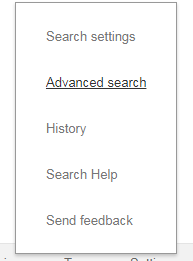
There is a way around it but it is rather long-winded. You need to go to Settings - use either the link in the bottom right hand corner of your Google home page or the one near the top of a search results page - and click on Advanced Search .
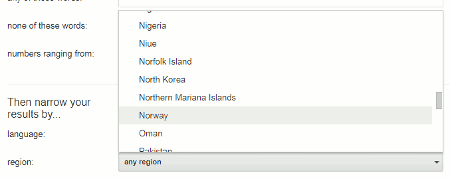
On the Advanced Search screen scroll down to “Then narrow your results by…” and use the pull down menu in the region box to select the country.
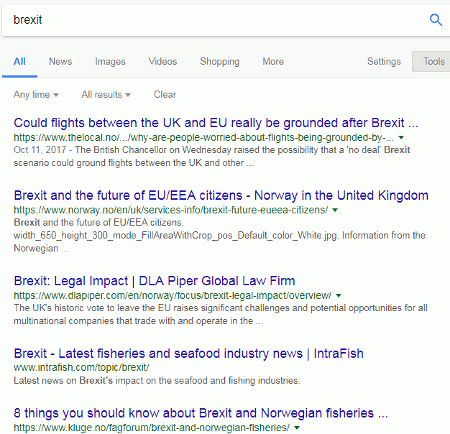
I ran a search on Brexit in google.co.uk, google.no and a few other country versions of Google. All gave me essentially the same results.
Using the region filter and selecting Norway as the country I am given the following by Google:
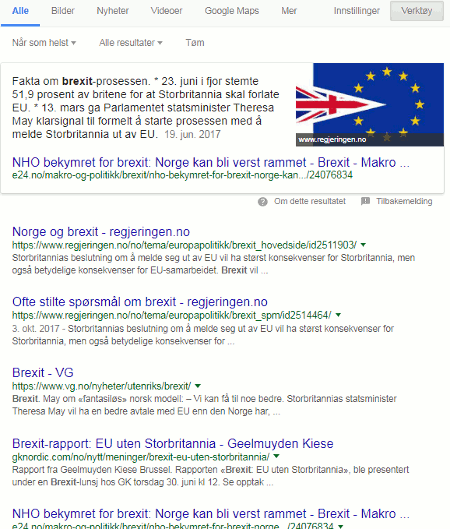
Notice, though, that Google is giving me English articles or English versions of them. Google has decided that I would prefer English articles and I have to scroll down to number 10 and beyond to see pages in Norwegian. To get a broader view of what is being said in Norway about Brexit I have to go back into settings, click on Languages and choose Norwegian/Norsk.
Oh - and you get slight different results if you go through a VPN and set Norway as the country.
What worries me even more is that Google could do away with the advanced search screen and the region filter with it.
Google says:
We’re confident this change will improve your Search experience, automatically providing you with the most useful information based on your search query and other context, including location.
No, Google. You have just made things more difficult for those of us who conduct serious, in-depth research. The way I feel about this change at the moment is that if you were a person I would take a baseball bat to your head!
UPDATE: In response to David Pearson's comment and reminder below.
Including a site command e.g. site:no in the search works relatively well for this particular example (Norway) and gives good but slightly different results. It will, of course, miss Norwegian sites that are registered as .com or other international domains. The amount of overlap (or lack of it) will vary depending on the country. It's another one to add to the list of strategies, which I am sure will become longer, for dealing with this problem.
Wednesday, 16 August 2017
RIP OFFSTATS
I received an email from them explaining that they no longer have the resourcing available to maintain and develop the database. Also, as much of the content can now be discovered through other approaches they felt the need for this type of search tool was not so relevant as it had been a few years ago.
A shame but understandable from their point of view. It was always a popular resource on my search workshops and often featured in the participants' "Top Ten Tips". It was one of the few resources of this type in which humans assessed and monitored the quality and relevance of the sites listed. Very sorry to see it go.
Saturday, 10 June 2017
Another example of Google's Knowledge Graph getting it wrong
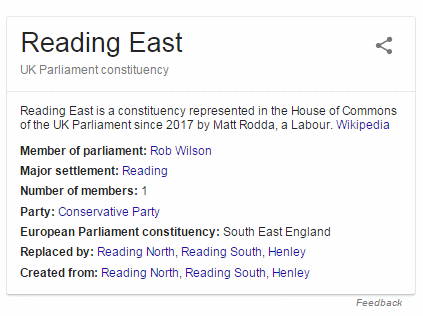
I took this screenshot yesterday (Friday, 9th June) at around 8 a.m. and expected to see Rob Wilson given as the MP throughout . I was impressed, though, to see that the snippet from Wikipedia correctly gives Matt Rodda as our MP. Whoever had updated that entry was pretty quick off the mark. Possibly a Labour Party worker? The rest of the information, which is taken from Google's database of "facts", is either wrong, confusing or nonsensical.
"Member of Parliament: Rob Wilson" - wrong. But he was MP until around 4 a.m. on the 9th June when the result of the election in Reading East was announced, so perhaps I am expecting a little too much from Google to be that quick about updating its facts.
"Major settlement: Reading" - yes we are part of Reading but I find it strange that it is referred to as a major settlement rather than a town.
"Number of members: 1" - not sure why that is there as each constituency can only have one MP.
"Party: Conservative" - correct for Rob Wilson but the new MP is Labour.
"European Parliament constituency: South East England" - correct!
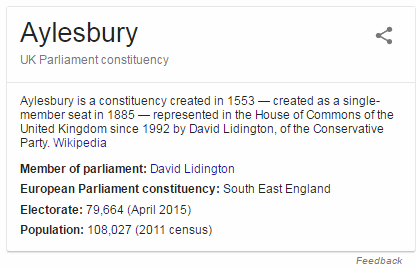
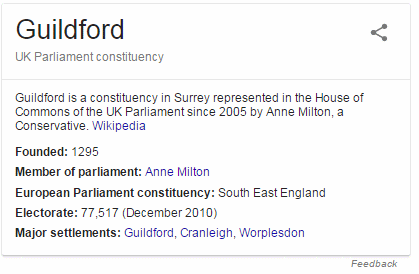
The final two lines "Replaced by:" and "Created from:" had me totally flummoxed. The entries are the same - Reading North, Reading South, Henley. Reading North and Reading South were constituencies formed by splitting the Reading constituency in 1950. They were then merged back into Reading in 1955, re-created in 1974, and in 1983 Reading East and West were formed (Yes, it's complicated!). As for Henley, it is not even in the same county. I can only think that this comes from Caversham (now part of Reading East) being part of Oxfordshire until 1911, when it probably did fall within the Henley constituency. The "Replaced by" is wrong because Reading East has not been replaced by anything. Google can't even blame a template that has to be filled in with information at all costs because different information appears in the Knowledge Graph depending on the constituency.
Here is the information for Aylesbury:
And the one for Guildford:
Going back to the how up to date the information is, how quickly does Google update their "facts". Rob Wilson was still our MP mid Friday afternoon. I submitted feedback using the link that Google provides at the bottom of each Knowledge Graph but this morning (10th June) nothing had changed. I'll update this posting when it does change.
I would hope that most people would look at the other links in the search results, in this case the latest news, but preferably a reliable authoritative source. The list of MPs on the UK Parliament website would be an obvious choice but might take a day to be updated after an election. Just don't rely on Google to get it right.